
The Problem we Face
This book solves a real-world problem. If you’re not personally impacted by it, then you’re most definitely aware of it. This problem has a negative impact on not just our minds, but our bodies, our beliefs, our stories, our culture, and our society. It stems from failures within the systems that affect us each individually and as a whole. In 2023, the U.S. Surgeon General put out an advisory on the healing effects of social connection and community. This advisory was titled "Our Epidemic of Loneliness and Isolation."
Epidemic Levels of Loneliness and Isolation are a Public Health Crisis
The advisory argues that social connection is a biological necessity. Not a want. Not a lifestyle preference. A need. When individuals within a community are connected, the community thrives. And when we are disconnected, members of the community are forced into survival. This erosion of connection has measurable consequences for mortality, chronic disease, mental health, economic productivity, and democratic functioning, to name a few.
Human beings are biologically wired for connection. Not performance. Not strategy. Not emotional self-management in isolation. Not hyperindependence. Connection is a survival need, as essential as food, water, and shelter. When that need is unmet, the body and mind adapt. Humans are extremely innovative and have numerous skills we rely upon to ensure our survival, but those adaptations can become harmful and even detrimental when applied long term. They pop up as anxiety, withdrawal, control, manipulation, hyper-vigilance , resilience, denial, emotional games, greed, addiction, etc.
The Surgeon General now recognizes loneliness and social isolation as a public health crisis, not a personal weakness. It’s a sign that our social system isn’t healthy.
A Look at the Numbers
Loneliness and Social Isolation
- Approximately 1 in 2 U.S. adults report experiencing loneliness
- Only 39% of U.S. adults report feeling very emotionally connected to others
- Less than 20% of people who feel lonely recognize it as a serious problem, delaying intervention
Erosion of Social Infrastructure
The advisory documents decades-long declines in:
- Time spent with friends (↓ 20 hours/month since 2003)
- Community participation
- Trust in others and institutions
- Family and household size
- Civic, religious, and group involvement
These are not individual choices alone, but structural changes that reduce opportunities for connection.
Health Consequences of Social Disconnection
Mortality & Physical Health
- Loneliness increases risk of premature death by ~26%
- Social isolation increases risk of premature death by ~29%
- Overall lack of social connection raises mortality risk equivalent to smoking up to 15 cigarettes per day
- Meta-analysis of 148 studies shows social connection increases odds of survival by 50%
Cardiovascular Disease
Poor social relationships are associated with:
- 29% increased risk of heart disease
- 32% increased risk of stroke
Lonely heart failure patients show:
- 68% higher hospitalization risk
- 55% higher readmission risk
Cognitive Decline & Dementia
- Chronic loneliness and isolation increase dementia risk by ~50%
- Cognitive decline occurs 20% faster in chronically lonely older adults
Mental Health & Suicide
- Loneliness more than doubles risk of depression
- Among men, living alone more than doubles suicide risk
- Social isolation is described as one of the strongest predictors of suicidal behavior across populations
Economic & Societal Costs
- $6.7 billion/year in excess Medicare spending due to social isolation among older adults
- $154 billion/year in workplace losses from stress-related absenteeism linked to loneliness
- Reduced educational attainment, productivity, and civic participation
The advisory explicitly connects social disconnection to weakened democracy, polarization, and institutional distrust.
Groups at Highest Risk
The advisory identifies disproportionate risk among:
- Young adults (loneliness rising steadily since 1976)
- Older adults
- People with chronic illness or disabilities
- Low-income individuals (63% of adults earning < $50k are lonely)
- People living alone
- Single parents
- LGBTQ+ individuals
- Racial and ethnic minorities
- Rural residents
- Survivors of violence and discrimination
Importantly, the advisory stresses these risks are not inherent traits, but outcomes of structural and social conditions.
The Role of Technology
Key data:
- Americans spend ~6 hours/day on digital media
- Social media use rose from 5% (2005) to ~80% (2019)
- Using social media >2 hours/day doubles odds of perceived social isolation
Technology can:
- Support connection (especially for marginalized groups)
- Erode connection by displacing in-person interaction, reducing interaction quality, and increasing comparison, harassment, and loneliness
The advisory calls for reform of digital environments, not elimination.
How Social Connection Affects Health
The document identifies three interlocking pathways:
Biological
- Stress hormones
- Inflammation
- Immune response
- Gene expression
Psychological
- Meaning and purpose
- Perceived safety
- Stress regulation
- Resilience
Behavioral
- Sleep
- Nutrition
- Physical activity
- Treatment adherence
This is a systems-level explanation, not an individual one.
Solutions Proposed: A National Strategy
The Six Pillars to Advance Social Connection
- Strengthen social infrastructure (parks, libraries, transit, community spaces)
- Enact pro-connection public policies
- Mobilize the health sector to treat social connection as a health determinant
- Reform digital environments
- Invest in research and measurement
- Cultivate a culture of connection (norms, values, stigma reduction)
Whole-of-Society Approach
Recommendations are tailored for:
- Governments
- Healthcare systems
- Schools
- Workplaces
- Tech companies
- Media
- Community organizations
- Parents and individuals
The advisory explicitly rejects placing responsibility solely on individuals.
Critical Framing Insight
The most important takeaway is that loneliness is framed as:
- A predictable outcome of misaligned systems
- A public health issue requiring structural intervention
- A reversible condition when environments support connection
This framing aligns social connection with health equity, trauma-informed policy, and systems design, rather than self-help or moral failure.
What’s Love Got To Do With It?
This framing aligns social connection with health equity, trauma-informed policy, and systems design, rather than self-help or moral failure. This matters for anyone wanting to understand their romantic relationships, because most “relationship problems” are actually connection injuries playing out in private.
Modern relationships are under impossible strain:
- ~50% of U.S. adults report experiencing lonelines
- Only 39% feel deeply emotionally connected to others
- Time spent with friends has dropped by 20 hours per month over two decades
- Trust in others has fallen from ~45% (1970s) to ~30%
- Community, family, and social supports have steadily eroded
As collective connection declines, romantic relationships are forced to carry the full weight of belonging, regulation, meaning, and safety, a load they were never designed to bear alone.
This is the hidden backdrop behind:
- Anxious attachment
- Avoidance
- Power struggles
- Hot-cold dynamics
- Emotional withdrawal
- “Playing it cool”
- Testing, chasing, or withholding
These are not character flaws. This is self-preservation. These are protective survival strategies inside connection-deprived systems.
What Disconnection Does to the Body and Brain
The advisory documents that chronic loneliness and poor-quality relationships:
- Increase risk of premature death by ~26–29%
- Carry a mortality risk equivalent to smoking up to 15 cigarettes a day
- Raise risk of heart disease (+29%), stroke (+32%), depression, anxiety, and dementia (~50% increase)
- Disrupt stress hormones, immune function, and inflammation
- Increase suicide risk, especially among men living alone
Translation for love:
When someone is disconnected, their nervous system is already under threat. They are not choosing games, they are trying to regulate fear, scarcity, and uncertainty.
Why “Relationship Advice” Often Makes Things Worse
Most modern dating and relationship advice:
- Teaches strategic withholding
- Encourages power imbalance
- Rewards emotional unavailability
- Frames safety as weakness
- Treats vulnerability as a risk to manage
But the evidence shows:
- High-quality connection is protective
- Emotional support lowers stress and improves health
- Meaning, purpose, and safety emerge through mutual presence, not control
Games don’t build desire. They build distance, ambiguity, and nervous system dysregulation.
Love Is a System, Not a Performance
The advisory emphasizes that connection is shaped by:
- Structure (how often we connect, with whom)
- Function (whether support is available)
- Quality (whether interactions are safe, respectful, and meaningful)
Healthy love requires conditions, not tactics:
- Emotional safety
- Predictability
- Trust & Integrity
- Mutual responsiveness
- Repair after rupture
- Shared reality, not hidden agendas
When these conditions are present, connection stabilizes. When they are absent, people compensate, with strategies that look like games.
The Way Forward: Love Without Games
Love Without Games is not anti-desire, anti-mystery, or anti-romance. It is anti-exploitation in a disconnected culture.
This book aligns with the Surgeon General’s call to:
- Treat connection as foundational, not optional
- Stop moralizing survival strategies
- Build relationships that regulate instead of destabilize
- Replace manipulation with mutuality
- Replace performance with presence
Love heals when the system supports it. Games disappear when safety is restored.
If love has felt confusing, exhausting, or unsafe, it is not because you failed to play the game correctly. It is because you are trying to meet a biological need in a culture that taught you to perform instead of connect.
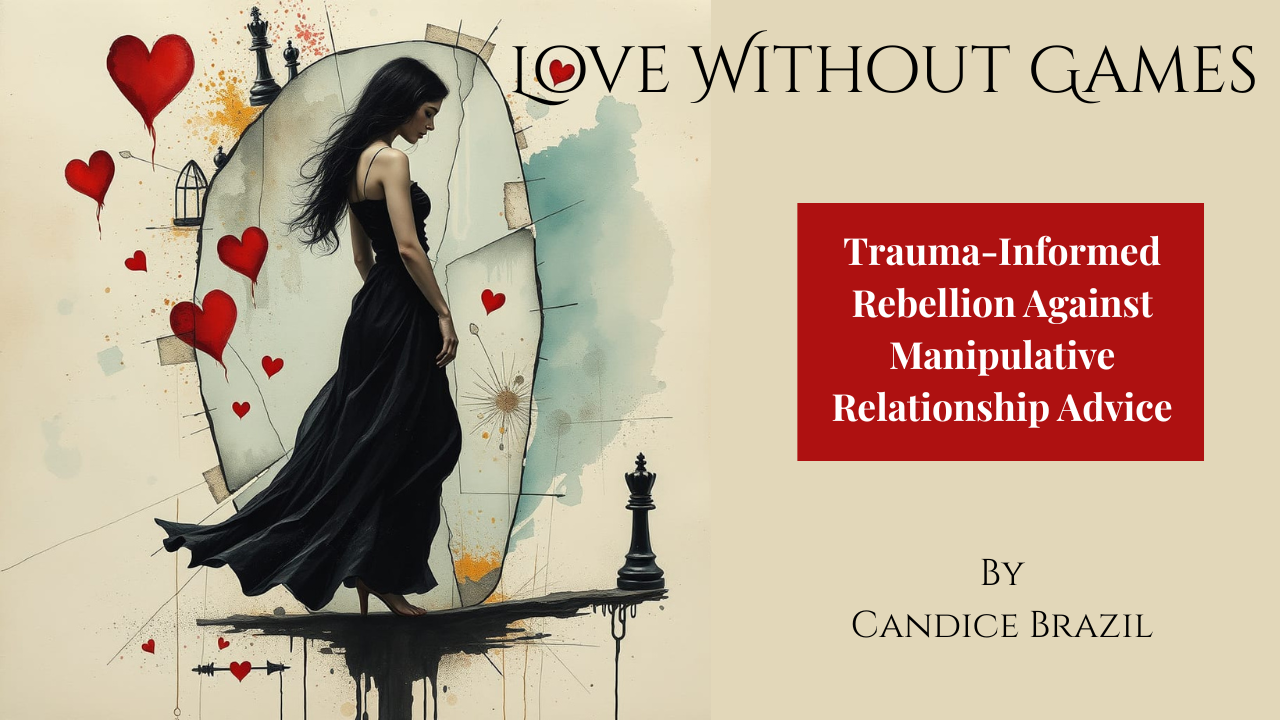
This book exists to help you step out of that system, and into a kind of love your nervous system can finally trust.

0 Comments