


Losing the Sense of “Mine” in Body and Self
Boundary Collapse After Abuse: Key Takeaways
Boundary collapse is a Holey House teaching concept for the erosion of a person’s felt sense that their body, emotions, privacy, attention, and choices are their own. It is not a psychiatric diagnosis, a legal term, or a scientifically validated stage of abuse. The phrase describes a change in felt ownership and permission, not an actual transfer of rights. A person causing harm may act entitled to a child’s body or inner world. A family may enforce that entitlement. A child may eventually experience resistance as unthinkable, dangerous, pointless, or disloyal. None of this makes the access legitimate. The survivor remained a person, never property.
Boundary collapse may overlap with parent–child boundary dissolution, coerced compliance, dissociation, depersonalization, disrupted self-concept, negative body image, or difficulty sensing internal states. Those constructs are related but not interchangeable. Not every survivor experiences them, and none can prove that abuse occurred. Within the Holey House Entrapment & Control sequence, boundary collapse follows graduated boundary violation and desensitization. The line has been crossed repeatedly; the crossing has been made familiar; now the survivor may lose reliable access to the conviction that there should be a line at all. The next movement (dependency engineering) uses that confusion to make the person causing harm seem necessary for identity, safety, belonging, or interpretation.
What Boundary Collapse After Incest and Abuse Really Means
For a long time, I thought a boundary was only real if I could state it clearly, defend it successfully, and endure whatever happened after I said no. If I did not know what I wanted, I assumed I had no preference. If I noticed discomfort only after an interaction, I assumed it had not mattered during the interaction. If another person felt wounded by my limit, I treated their pain as evidence that my limit was cruel. I did not yet understand that a boundary can be violated before a child has language for it, and can remain violated even after the child has been trained not to feel entitled to name it.
Boundary collapse is the point at which the question is no longer only, “Will this person respect my boundary?” It can become, “Am I allowed to have a boundary from this person? Is my body actually mine in this relationship? Are my feelings information, or are they problems I must erase?”
“Mine” Is More Than Possession
In this article, mine does not mean isolation, selfishness, or refusal to share. It names psychological and bodily sovereignty: the basic fact that a person is the subject of their own life.
That sense of “mine” can include:
- Body: Touch, pain, hunger, rest, privacy, sexuality, movement, and medical or caregiving contact happen to my body. My response matters.
- Emotion: I may care about another person’s feelings without being required to manufacture, hide, or surrender my own feelings for them.
- Thought and privacy: My inner world is not automatically available for inspection, ridicule, confession, or correction.
- Choice and agency: My preferences, refusals, changing mind, and uncertainty carry information. Another person’s greater power does not turn their desire into my decision.
- Role and identity: A child is not a parent’s romantic partner, therapist, confidant, regulator, substitute spouse, or emotional possession. Love does not erase the distinction between two people.
Healthy connection allows “mine,” “yours,” and “ours” to coexist. Boundary collapse blurs those categories under pressure. The abusive person’s wants can be treated as shared needs. The child’s distress can be renamed betrayal. The family’s reputation can be made the child’s responsibility. Access can be presented as love, and separation as injury. The child may still have an internal reaction (fear, disgust, anger, confusion, pain, numbness, a wish to disappear) but lose confidence that the reaction authorizes anything. The signal exists. Its jurisdiction has been attacked.
Boundary Collapse Is Not the Same as a Boundary Being Crossed
A boundary violation is an action: someone enters privacy, uses unwanted touch, sexualizes a relationship, overrides a refusal, demands emotional caretaking, or punishes separateness. Boundary collapse describes a possible cumulative effect: the survivor’s felt ability to locate, trust, or act from the distinction between self and other has been eroded. A child can experience many violations without developing this particular pattern. A survivor can retain a fierce sense of internal separateness while being unable to stop what happens externally. Another can appear highly independent in public while feeling no ownership in one specific relationship. Boundary collapse is not all-or-nothing, and it need not affect every area of life. The distinction matters because “poor boundaries” is often used to blame the person who was overpowered. A child did not cause abuse by failing to construct an adult-proof perimeter. It was the adult’s duty to recognize and protect the child’s bodily autonomy, developmental needs, privacy, and role.
Parent–Child Boundary Dissolution Is a Research Construct; Boundary Collapse Is a Teaching Concept
The closest established research language is parent–child boundary dissolution. A 2024 meta-analysis by Thompson, Platts, and Davies describes it as a breakdown in boundaries or loss of psychological distinctiveness within the parent–child relationship. Across 478 studies, the authors organized the literature into patterns involving enmeshment or entanglement, disorganization and chaos, caregiving or role reversal, and coerciveness. Each pattern was associated with children’s psychological difficulties, although the strength and form of associations varied.
That literature is important, but it is not identical to the meaning used here. Boundary dissolution research covers many parent–child dynamics and does not by itself establish incest or sexual abuse. Holey House uses boundary collapse more narrowly to describe the survivor’s subjective loss of reliable access to “this is my body, my feeling, my choice, my self” under repeated relational intrusion and coercion. The overlap is conceptual, not diagnostic. One family behavior cannot prove a collapsed inner boundary, and one survivor response cannot identify what caused it.
Enmeshment Is Not Intimacy
Enmeshment is often mistaken for exceptional closeness because both involve emotional intensity and knowledge of one another. The difference is whether distinctness is permitted. Intimacy can tolerate a separate thought. Enmeshment treats it as withdrawal. Intimacy can hear no without making no a verdict on love. Enmeshment makes access a loyalty test. Intimacy recognizes a child’s development toward greater autonomy. Enmeshment recruits the child to stabilize the adult or family. Intimacy includes privacy. Enmeshment treats privacy as suspicion, rejection, or betrayal.
In incestuous systems, sexual boundary violations may be embedded in broader violations of role, privacy, emotion, and authority. The child may be told that the relationship is “special,” unusually mature, spiritually destined, more honest than other relationships, or necessary to keep the family together. What appears to be closeness can function as occupation of the child’s inner and bodily territory. This does not mean every close, collectivist, interdependent, multigenerational, caregiving, or emotionally expressive family is enmeshed. Culture, disability, illness, material conditions, and shared care can shape privacy and dependence without erasing personhood. The relevant questions concern coercion, developmental roles, freedom to differ, sexualization, access, retaliation, and whether care honors the person receiving it.
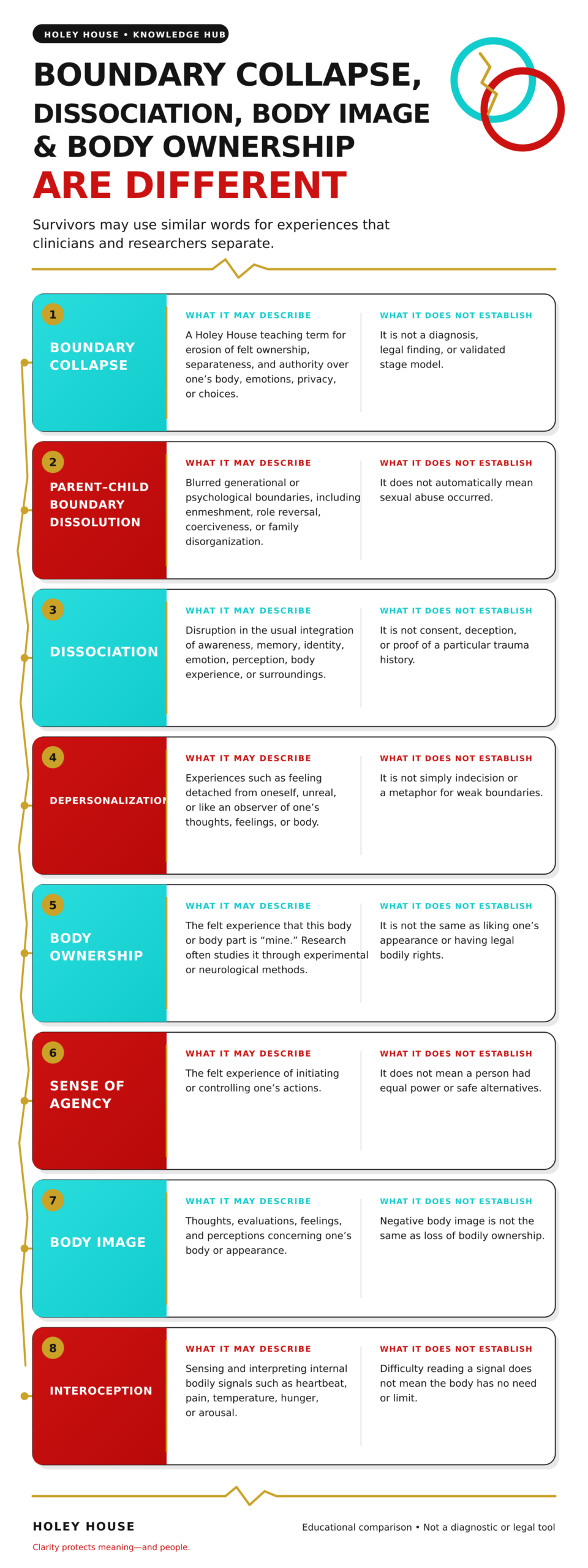
A 2018 meta-analysis by Vonderlin and colleagues found higher dissociation among people reporting childhood abuse or neglect, with considerable variation across studies. A systematic review and meta-analysis by Bödicker and colleagues found a small association between childhood maltreatment and negative cognitive-affective body image in adulthood. These findings support attention to dissociation and body experience, but they do not merge the constructs or make either one a marker of incest.
Research on trauma and experimental body ownership is much smaller. A 2018 pilot study by Rabellino and colleagues used a rubber-hand illusion task with only 17 participants across three groups. Its findings suggested possible differences in body ownership and agency among participants with post-traumatic stress and dissociative symptoms, but the sample was far too small to justify sweeping conclusions about survivors. The honest conclusion is that altered embodiment after trauma is plausible and under study; not that science has validated a single “boundary collapse” mechanism.
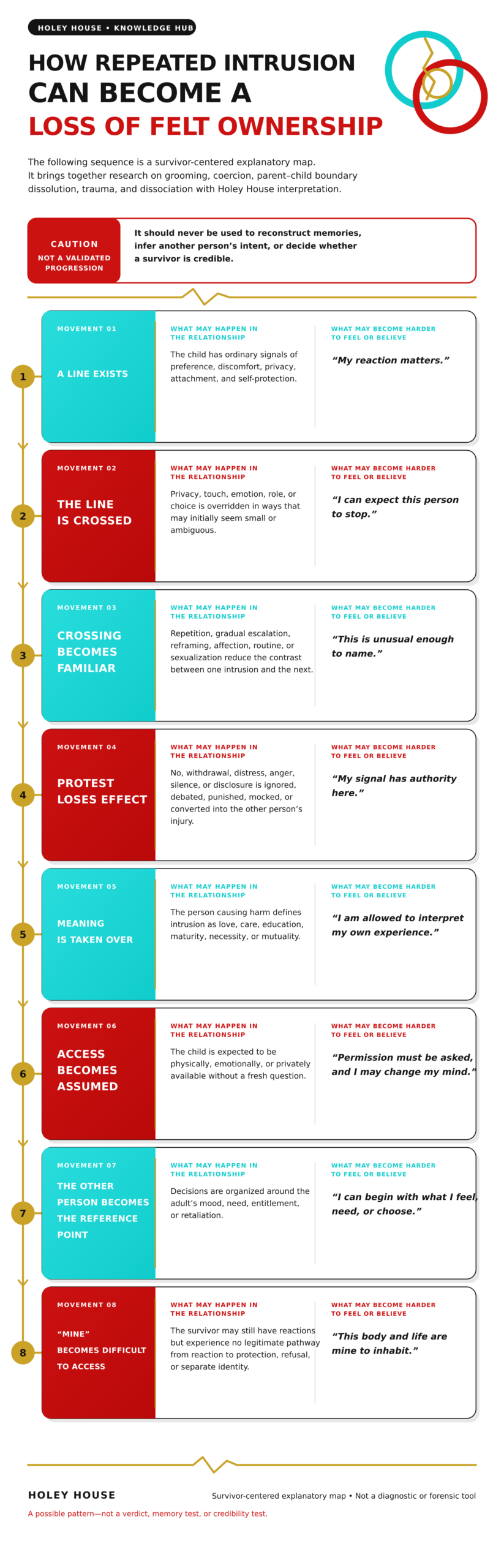
Real experiences may skip movements, reverse direction, or look nothing like this map. Some abuse begins suddenly. Some survivors never lose an internal sense of ownership. Others experience collapse in sexual situations but not at work, with one family member but not another, or only when particular power dynamics are present. The map explains how repeated intrusion can alter a survivor’s internal reference system. It does not excuse the intrusion and does not turn adaptation into permission.
Felt Ownership Can Be Damaged; Actual Ownership Was Never Transferred
This is the sentence I needed before I had language for any of the rest: They could damage my access to the feeling that I belonged to myself. They could not make me belong to them. An abusive person may behave as though access creates ownership. A family may reinforce the claim. A survivor’s nervous system may organize around anticipated access because doing so reduces surprise or danger. But repetition does not convert violation into a right. Nor does the survivor need to have felt a clear inner no at every moment.
A child may have been confused, attached, curious, numb, physically responsive, frightened, affectionate, or unable to separate their wish for closeness from the contact imposed on them. None of those states gives an adult permission to sexualize or exploit the relationship. Boundaries are not valid only when perfectly felt. Consent is not created by the survivor’s inability to locate a preference under coercion. The responsibility remained with the person who held greater age, knowledge, authority, access, or power.
Common Myths About Boundary Collapse and Bodily Ownership
Myth: The Survivor’s Weak Boundaries Caused the Abuse
What we know: Children are not responsible for creating boundaries strong enough to stop adults. Adults and institutions are responsible for maintaining safe roles, respecting bodily autonomy, and protecting children from sexualized or exploitative access. What later looks like “weak boundaries” may be the footprint of repeated override. Naming the footprint as the cause reverses the direction of responsibility.
Myth: Boundary Collapse Means the Survivor Has No Self
What we know: A survivor may lose reliable access to preferences, anger, privacy, bodily signals, or separate identity in certain conditions without becoming an empty person. The self may be obscured, divided, strategically hidden, organized around survival, or easier to feel in some relationships than others. The adaptation is not proof of absence. Even inward resistance that never became visible was still a form of distinction.
Myth: If the Survivor Could Not Feel a Clear No, the Contact Was Consensual
What we know: Consent requires more than the absence of a recognizable refusal. The CDC defines sexual violence as sexual activity when consent is not obtained or freely given. A child cannot turn incestuous sexual activity into informed consent through silence, affection, compliance, confusion, lack of language, or failure to resist. For adults, coercion, threats, exploitation of dependence, intoxication, incapacity, fear, and abuse of authority can also remove the conditions for free agreement. Uncertainty is not an invitation for another person to decide.
Myth: A Physical Response Proves the Body Said Yes
What we know: Bodies can respond automatically during unwanted or abusive experiences. Sensation, lubrication, erection, orgasm, freezing, numbness, pain, or the absence of pain does not establish desire, choice, moral responsibility, or consent. The body is not a witness for the prosecution against the survivor. An involuntary response cannot authorize another person’s behavior.
Myth: Enmeshment Is Just a Very Loving Family
What we know: Love and interdependence do not require the erasure of generational roles or psychological distinctness. A child can be close to family and still have privacy, developmental freedom, bodily autonomy, and permission to disagree. The issue is not how much people care or communicate. It is whether connection depends on access, obedience, emotional caretaking, secrecy, sexualization, or punishment for separateness.
Myth: Boundary Collapse Always Looks Passive
What we know: A threatened sense of self can appear as compliance, but it can also appear as rigid control, automatic opposition, intense privacy, perfectionism, rapid withdrawal, people-pleasing, overexplanation, or different responses in different settings. No behavior reveals the mechanism by itself. An apparently firm limit may be freely chosen, fear-driven, context-specific, or all three. A quiet response may reflect calm, freeze, calculation, dissociation, uncertainty, or something else entirely.
Myth: Every Survivor Feels Detached From Their Body
What we know: Survivors vary enormously. Some report depersonalization, numbness, or feeling that the body is an object. Others feel intensely embodied, vigilant, or protective of bodily space. Some move between states. Many do not identify with body-ownership language at all. The National Child Traumatic Stress Network notes that complex trauma can be associated with both heightened reactivity and disconnection from bodily or emotional experience. These are possible adaptations, not required symptoms.
Myth: Difficulty Identifying a Preference Means There Is No Preference
What we know: A person may need time to perceive what they feel when attention has long been organized around someone else’s mood, demand, or retaliation. Delayed awareness does not make the later information false. At the same time, no framework should pressure a survivor to discover a hidden answer. “I do not know,” “not now,” “I need more information,” and a changed answer all communicate present limits.
Myth: A Survivor Who Initiated Contact Could Not Have Experienced Boundary Collapse
What we know: Initiation can have many meanings in an abusive or coercive system: anticipation of what seems inevitable, an attempt to control timing, attachment-seeking, reenactment of a taught role, hope for affection, a strategy to reduce uncertainty, or genuine desire within a relationship that is still exploitative because of age or power. Behavior must be understood in context. A child’s participation cannot make an adult–child sexual relationship equal or consensual.
Myth: Boundary Collapse Is a Personality Disorder or Psychosis
What we know: Boundary collapse is not a diagnosis. Experiences of blurred identity or bodily estrangement can occur in trauma-related conditions, dissociative disorders, personality disorders, psychosis-spectrum conditions, neurological conditions, sensory-processing differences, depression, anxiety, medical illness, substance effects, or ordinary moments of uncertainty. Shared language does not mean shared cause. Clinical assessment should examine the specific experience, timing, context, functioning, medical factors, and differential diagnoses rather than replacing them with a metaphor.
Myth: The Framework Can Prove Abuse or Recover Missing Memories
What we know: Difficulty with boundaries, agency, body experience, or identity is nonspecific. It cannot prove incest, identify a person who caused harm, or fill gaps in autobiographical memory. A survivor-centered framework should create language for what is known, not pressure certainty about what is unknown. Compassion does not require suggestion, and accuracy does not require disbelief.
How Boundary Collapse Affects Incest Survivors
Boundary collapse may leave a survivor with a strange double knowledge: I live in this body, but I do not feel authorized to decide what happens to it. These are my feelings, but I experience them as assignments from someone else. This is my life, but I keep waiting for permission to inhabit it. Not every survivor will recognize this. For those who do, the pattern can appear less like one symptom than an organizing rule learned inside relationship.
The Body May Feel Like an Obligation or Object
Some survivors describe the body as something managed for other people: presented, hidden, corrected, inspected, used, protected from attention, or made available. Hunger, fatigue, pain, arousal, illness, and discomfort may feel negotiable until someone else confirms them. Others experience the body as dangerous because it drew attention, responded automatically, changed during puberty, carried visible resemblance to family, or holds sensations associated with abuse. Shame can attach to the body for what another person chose to do.
Body image and body ownership should not be confused. A survivor may appreciate their appearance while feeling little authority over touch. Another may strongly experience the body as theirs while struggling with appearance-related shame. Research supports an association between childhood maltreatment and negative body image at the population level, but the average effect is modest and cannot predict an individual person’s experience.
Feelings May Be Experienced as Other People’s Property
In an enmeshed or coercive family, a child may learn that their emotional role is to keep an adult calm, admired, unashamed, sexually gratified, or connected. The child’s anger becomes cruelty. Fear becomes accusation. Disgust becomes immaturity. Sadness becomes ingratitude. Pleasure or affection is seized as proof that the entire relationship was acceptable. The survivor may later monitor another person’s emotional weather before noticing their own. They may experience guilt when someone is disappointed even if no wrongdoing occurred. They may answer “What do you want?” with a calculation of what will preserve connection. This is not evidence that survivors lack empathy or agency. It can reflect an environment where reading others was important and being readable oneself was dangerous.
Choice Can Become a Search for the Correct Answer
When preferences were debated, punished, sexualized, mocked, or ignored, choice may cease to feel like self-expression. It can become a test with a hidden answer. A survivor may ask permission for ordinary needs, overexplain a refusal, agree before checking inward, wait for someone else to choose, or feel panic when offered too many options. They may change an answer after noticing discomfort and then accuse themselves of manipulation or inconsistency.
Delayed information is still information. A choice made under one understanding can change when the person has more time, context, or bodily awareness. That is not a defect in consent; the ability to revise is part of consent.
Privacy Can Feel Like Deception
If closed doors, private thoughts, diaries, friendships, clothing, bathing, devices, or sexual development were monitored or invaded, privacy may become morally charged. Keeping something for oneself can feel like lying. Disclosure can become a reflex even when no one has earned the information. The opposite pattern can also occur: extreme secrecy may feel like the only possible form of selfhood. Both patterns can make sense when ordinary privacy was never treated as ordinary.
Neither pattern proves abuse. They are possibilities that become meaningful only in the context of the survivor’s history and present experience.
The Survivor May Confuse Another Person’s Access With Their Own Consent
Repeated access can create a powerful false equation: If they can reach me, I must have allowed it. If I remained, returned, loved them, depended on them, or did not stop them, access must have been mutual. But access and consent answer different questions. Access may come from family structure, caregiving, age, isolation, authority, economic dependence, shared housing, fear, or gradual conditioning. Consent concerns whether a person freely and presently agrees. Incest exploits access that family relationship already provides. The child’s need for care and attachment does not become permission for sexual behavior. The survivor did not create mutuality by being reachable.
Dissociation May Intensify the Sense of Not Belonging to Oneself
Some survivors describe observing the body from far away, losing time, feeling unreal, becoming emotionally blank, or experiencing sensations without a connected sense of “this is happening to me.” Dissociation can interrupt the usual integration of body, emotion, memory, and identity, which may deepen the language of not feeling like one’s own person. Yet dissociation and boundary collapse are not synonyms. A person may dissociate during an accident, panic episode, medical procedure, or other trauma without a history of relational boundary erosion. A survivor may experience profound boundary confusion without dissociative symptoms. The distinction prevents a survivor’s metaphor from being turned into an unsupported diagnosis.
Self-Blame Can Attach to the Adaptation
Boundary collapse can produce a cruel retrospective standard. The adult survivor looks backward with knowledge and options the child did not have, then asks why the child did not demonstrate a fully developed, freely enforceable self.
I once read my confusion as consent, my attachment as endorsement, and my adaptation as character. I put my survival response on trial while leaving the architecture of coercion unexamined. The more accurate sequence was not “I had no boundaries, so abuse happened.” It was “someone repeatedly crossed boundaries, controlled their meaning, and made resistance costly; my sense of what I could claim as mine adapted to those conditions.” That explanation does not reduce a survivor to powerlessness. It locates responsibility where power was exercised.
Long-Term Mental and Physical Health Relevance
Child sexual abuse and chronic interpersonal trauma are associated with elevated risks across mental, behavioral, relational, sexual, and physical health domains. The CDC’s child sexual abuse overview identifies associations with depression, post-traumatic stress symptoms, substance misuse, suicidal behavior, later victimization, and some chronic physical health conditions. The CDC’s sexual violence overview also notes possible long-term reproductive, gastrointestinal, cardiovascular, sexual, and mental health effects.
These are population-level associations, not destiny and not proof of a single cause in an individual case. Genetics, other adversity, discrimination, material conditions, medical factors, relationships, and access to care can all influence outcomes. Evidence does not establish that boundary collapse itself directly causes a particular disease. The careful claim is that abuse and complex trauma can affect self-concept, emotion regulation, bodily experience, relationships, and health, while loss of felt agency or ownership may describe one part of some survivors’ lived experience.
Survivor Relevance Without a New Test to Pass
You do not need to recognize boundary collapse for your abuse to count. You do not need to feel estranged from your body. You do not need to remember a time when “mine” disappeared. You do not need to show the right combination of indecision, dissociation, shame, or enmeshment. And if this language does fit, it is not a verdict that you were absent from your own life. It may name how thoroughly another person’s entitlement was installed around you—and how much effort survival required when your own signals were denied authority. Your adaptation describes the pressure. It does not belong on the charge sheet against you.
How Partners Can Understand Boundary Collapse
A partner may see uncertainty and assume indifference. They may hear a delayed no and interpret it as inconsistency. They may experience a survivor’s attention to their mood as extraordinary closeness without realizing that the attention was once compulsory. Understanding boundary collapse means refusing to turn those patterns into entitlement.
Uncertainty Is Not Permission
If a survivor says “I don’t know,” goes quiet, becomes still, checks the partner’s face before answering, or changes their mind after initially agreeing, the safest interpretation is not “yes unless proven otherwise.” Consent must be freely given, specific, current, and capable of being withdrawn. A partner’s disappointment does not make the survivor responsible for continuing. Nor should a partner use a trauma framework to announce what the survivor “really wants.” The survivor is the authority on their present answer—including when that answer is uncertainty.
A Delayed Boundary Is Still a Boundary
Some survivors recognize discomfort during an interaction. Others notice it minutes, hours, or days later. That delay may reflect dissociation, attention organized around the partner, fear of conflict, unfamiliarity with bodily signals, ordinary reflection, or many other factors. A partner can understand the information without demanding that the survivor prove why it arrived late. The arrival time does not determine whether the limit matters now. This does not require a partner to pretend the past can always be retroactively known with certainty. It requires distinguishing good-faith ambiguity from a present obligation: once a boundary is communicated, it deserves respect.
Care Is Not Mind-Reading or Management
Partners can become overconfident in the language of trauma. They may monitor the survivor’s body, diagnose every pause as a freeze response, decide which preferences are “authentic,” or insist that they know when the survivor is dissociating. That can reproduce the very structure the framework is meant to expose: someone else becoming the final interpreter of the survivor’s inner world. Understanding is not ownership. A partner can take observable cues seriously, ask rather than assume, accept uncertainty, and remain responsible for their own emotions and boundaries. The goal is not to become a benevolent manager of the survivor’s self.
Mutuality Requires Two People, Not a Merger
A survivor’s history does not erase the partner’s personhood. Partners have their own limits, needs, consent, privacy, and right to leave an interaction or relationship. Respect is not one person becoming endlessly available so the other never feels abandoned. The relevant distinction is between having a boundary and enforcing it through punishment, threat, shame, sexual pressure, surveillance, or coercive withdrawal. “I am not available for this” preserves two people. “You must give me access or prove you love me” attacks distinctness. Healthy mutuality does not require perfect symmetry in every moment. It requires that neither person’s body, mind, or choices become the other’s property.
A Survivor’s Affection Does Not Cancel the Harm
Incest survivors may have loved, needed, protected, missed, defended, or sought comfort from the person who harmed them. Later, they may love a partner deeply and still become numb, uncertain, frightened, or distant during closeness.
Affection and alarm can coexist. Attachment does not certify consent. A partner who understands this does not force the survivor to choose between “I cared” and “I was harmed,” or between “I love you” and “I need a boundary.” Complex feeling is not a loophole in consent.
Partners Should Not Use the Concept as an Investigative Tool
Boundary collapse cannot reveal whether a specific event occurred, why a survivor behaves a certain way, or whether a family member had a particular intent. Partners should not interrogate, interpret gaps as evidence, or build a narrative the survivor has not provided. The concept is useful when it increases respect for personhood and context. It becomes harmful when it gives someone a new vocabulary for certainty, pressure, or control.
Therapist Considerations for Boundary Collapse, Agency, and Dissociation
Boundary collapse may be clinically useful as survivor language, but it should remain clearly identified as a non-diagnostic, non-validated teaching concept. Treatment formulation should translate the metaphor into specific experiences rather than treating the metaphor as an established syndrome.
Clarify What “Not Mine” Means for This Client
The phrase may refer to very different phenomena:
- unwanted access or coercive control in a current relationship
- difficulty identifying preferences or saying no
- shame, disgust, or negative body image
- depersonalization, derealization, identity discontinuity, or amnesia
- diminished sense of agency during action
- altered body ownership or neurological symptoms
- poor interoceptive awareness, chronic pain, or medical trauma
- role reversal, parentification, or enmeshment
- cultural or relational conflict about privacy and interdependence
- a metaphor for alienation rather than a perceptual disturbance
Assessment should ask about the form, timing, triggers, duration, functional impact, developmental context, power conditions, and the client’s own meaning. The phrase should not be converted into a diagnosis before its phenomenology is understood.
Differentiate Related Constructs Without Fragmenting the Survivor’s Story
Possible areas for differential assessment may include trauma- and stressor-related disorders, dissociative disorders, depersonalization/derealization, personality functioning, psychosis-spectrum symptoms, obsessive-compulsive phenomena, eating disorders and body dysmorphia, neurodevelopmental differences, sensory-processing patterns, sexual pain or dysfunction, substance effects, sleep disruption, medication effects, neurological conditions, and other medical causes. This is not a checklist for explaining away trauma. It is a reminder that accurate care requires both contextual understanding and diagnostic humility. The existence of another condition does not disprove abuse. A trauma history does not eliminate the need for medical or psychiatric evaluation. Multiple mechanisms can coexist.
Assess Power, Cost, and Permission; not Only Assertiveness
A client may know exactly what their boundary is and still be unable to enact it safely. Assessment that focuses only on communication skills can miss surveillance, financial dependence, threats, disability-related care, immigration concerns, family control, housing insecurity, religious authority, or fear of violence. Useful formulation questions concern what happened when the client previously differed, refused, delayed, closed a door, sought privacy, or named harm. Was the limit respected, ignored, debated, punished, sexualized, or made into evidence of disloyalty? What did compliance protect, and what did refusal risk? The aim is not to admire compliance or romanticize survival. It is to avoid labeling constrained behavior as a personality flaw while coercive conditions remain invisible.
Preserve Bodily Sovereignty in the Therapeutic Frame
Trauma-informed care rests on safety, trustworthiness, collaboration, empowerment, and attention to cultural, historical, and gender contexts, as described by SAMHSA. For clients whose boundaries were repeatedly overridden, the treatment frame itself carries meaning. Consent around touch, proximity, recording, telehealth privacy, body-focused interventions, medical coordination, exposure-based work, imagery, between-session contact, and release of information should be explicit and revisitable. A signed form does not eliminate the need for ongoing consent. Therapeutic expertise should not become ownership of interpretation. A clinician can offer hypotheses while leaving room for the client to disagree, decline, revise, or not know.
Avoid Suggestive Memory Work and Symptom-Based Certainty
Boundary confusion, dissociation, sexual difficulties, body shame, chronic pain, and relationship patterns are nonspecific. They cannot establish that incest occurred or identify who caused it. Clinicians should not use the boundary-collapse map to fill memory gaps, imply hidden events, or present one developmental explanation as fact. Document what the client reports, distinguish observation from inference, and tolerate uncertainty where evidence is incomplete. Validation can be precise: the client’s distress is real; their present boundaries matter; the behavior they describe can be evaluated; and uncertainty about unremembered details does not require either invention or dismissal.
Do Not Treat Compliance as Therapeutic Progress
A client who agrees quickly, praises the therapist, never objects, accepts every interpretation, or completes every assignment may be engaged, or may be organizing around authority. A client who questions, pauses, changes their mind, or declines may be providing clinically important information rather than “resisting treatment.” The therapist’s response to difference is part of the intervention environment. Debate, withdrawal, disappointment, overdisclosure, or subtle retaliation can reenact the rule that another person’s emotional state outranks the client’s boundary. At the same time, autonomy is not served by abandoning clinical judgment or withholding clear information. Collaboration allows expertise and personhood to coexist.
Keep Culture, Disability, and Caregiving Context Visible
Western individualism is not the universal standard for healthy boundaries. Shared decision-making, multigenerational homes, communal identity, family caregiving, and interdependence may be valued and sustaining. Disability or illness may require intimate assistance with bathing, dressing, mobility, communication, finances, or medical decisions. The clinical question is not whether a person is maximally independent. It is whether their dignity, privacy, assent or consent, developmental position, communication method, and right to express discomfort are honored, and whether dependence is being exploited. Care needs can change the form of a boundary. They do not erase the person who has it.
Attend to Current Safety and Reporting Duties
If the client describes current abuse, coercive control, stalking, sexual violence, danger to a child or vulnerable person, or imminent risk, assessment should address present safety and applicable law. Reporting duties vary by jurisdiction, profession, client age, and circumstances; clinicians should consult current local statutes, licensing requirements, supervision, and organizational policy. Limits of confidentiality should be explained in plain language before sensitive disclosure whenever possible. Surprise use of authority can be especially destabilizing for someone whose privacy and choices were historically taken from them.
Hold the Evidence at the Right Strength
Research strongly supports that child sexual abuse and complex trauma can be associated with diverse long-term difficulties. Research also supports associations among childhood maltreatment, dissociation, negative body image, disrupted self-concept, and parent–child boundary dissolution. Evidence is more limited for precise mechanisms connecting incest to altered experimental body ownership, and the term boundary collapse itself has not been validated as a clinical construct. It is a survivor-centered synthesis; not a biomarker, diagnosis, or universal causal pathway. That distinction protects both scientific integrity and survivors. It allows language to illuminate experience without making the survivor pass another test.
Closing Reflection: What Was Always Yours
Maybe the door was opened so often that you stopped believing it had ever been a door. Maybe someone called your body family property, your privacy secrecy, your anger cruelty, your fear confusion, your compliance love. Maybe they taught you that being reachable meant being willing, and being attached meant being owned. Access was never ownership. Familiarity was never consent. Your inability to defend a boundary did not erase the boundary. Your difficulty feeling “mine” did not make you theirs. The distinction between you and the person who harmed you remained ethically real even when they worked to make it psychologically difficult to reach.
I once believed the absence of a clean line meant there had been no violation. Now I understand that the missing line was part of the evidence of what repeated violation had done to my internal map; not proof that no line should have existed. The body they treated as available was still your body. The feelings they interpreted were still your feelings. The privacy they invaded was still your privacy. The choices they narrowed were still your choices. The self they obscured was still a self.
Boundary collapse names the damage to the sense of belonging to oneself. It does not grant the person causing harm retroactive possession. Within the Entrapment & Control sequence, this erosion prepares the next trap. When a survivor has been taught not to trust their own signals, the person causing harm can position themselves as the source of meaning, safety, belonging, and permission. That next process is dependency engineering.
Reflection Questions
Use only the questions that feel clarifying. They are invitations, not assignments.
- When you hear the word mine, which domain comes to mind first: body, emotion, privacy, choice, time, role, or identity?
- Were there relationships in which another person’s access was treated as automatic? How was that access explained?
- What happened when you expressed a different preference, interpretation, feeling, or need?
- Did affection, caregiving, dependence, secrecy, or family loyalty become confused with permission?
- Are there parts of your story where the phrase loss of felt ownership fits better than lack of boundaries?
- What would change in the meaning of your story if adaptation were understood as evidence of pressure rather than consent?
Research and Further Reading
Thompson, M. J., Platts, C. R., & Davies, P. T. (2024). Parent–child boundary dissolution and children’s psychological difficulties: A meta-analytic review. Psychological Bulletin, 150(7), 873–919. https://doi.org/10.1037/bul0000440
Vonderlin, R., Kleindienst, N., Alpers, G. W., Bohus, M., Lyssenko, L., & Schmahl, C. (2018). Dissociation in victims of childhood abuse or neglect: A meta-analytic review. Psychological Medicine, 48(15), 2467–2476. https://doi.org/10.1017/S0033291718000740
Bödicker, C., Reinckens, J., Höfler, M., & Hoyer, J. (2022). Is childhood maltreatment associated with body image disturbances in adulthood? A systematic review and meta-analysis. Journal of Child & Adolescent Trauma, 15(3), 523–538. https://doi.org/10.1007/s40653-021-00379-5
Ebrahim, B. K., Fouché, A., & Walker-Williams, H. (2022). Losses associated with childhood sexual abuse in women survivors: A scoping review. Trauma, Violence, & Abuse, 23(5), 1695–1707. https://doi.org/10.1177/15248380211013137. This review concerns women survivors and calls for further research; its findings should not be generalized to every survivor.
Rabellino, D., Burin, D., Harricharan, S., Lloyd, C., Frewen, P. A., McKinnon, M. C., & Lanius, R. A. (2018). Altered sense of body ownership and agency in posttraumatic stress disorder and its dissociative subtype: A rubber hand illusion study. Frontiers in Human Neuroscience, 12, 163. https://doi.org/10.3389/fnhum.2018.00163. This was a very small exploratory study and should not be treated as proof of a general trauma mechanism.
National Child Traumatic Stress Network: Complex Trauma—Effects
National Child Traumatic Stress Network: Sexual Abuse—Effects
Related Holey House Articles
Grooming Tactics and Sequence: How Trust Becomes a Trap
Graduated Boundary Violation: How Tiny Intrusions Become Major Breaches
Desensitization in Grooming and Abuse: How Survivors Are Conditioned to Normalize Harm
Dependency Engineering: How Abusers Make Themselves Feel Necessary
Progressive Entrapment: How Freedom Narrows One Step at a Time
Secrecy Systems and Isolation: How Abuse Controls the Story
Immediate Support
If this article connects with current danger or acute distress:
United States or Canada—Childhelp National Child Abuse Hotline: Call or text 800-422-4453; text GO to begin. Available 24/7. This is a support and information service, not an emergency line or substitute for reporting to local authorities.
United States—RAINN National Sexual Assault Hotline: Call 800-656-HOPE (4673), text HOPE to 64673, or use RAINN’s online chat. Available 24/7.
United States—National Domestic Violence Hotline: Call 800-799-SAFE (7233), text START to 88788, or use thehotline.org. Available 24/7.
United States—988 Suicide & Crisis Lifeline: Call or text 988, or use 988lifeline.org. Available 24/7/365.
If there is immediate danger, contact local emergency services. Outside the United States or Canada, use a trusted local crisis, sexual-assault, domestic-violence, child-protection, or emergency service.
This article is educational and is not a diagnosis, legal advice, or a substitute for individualized medical or mental health care.

0 Comments