


How Abusers Build Trust, Cross Boundaries, and Entrapment
TL;DR
Grooming is an intentional pattern used to gain access, build trust or compliance, weaken boundaries, reduce the chance of discovery, and maintain silence. It may target a child as well as the adults, family, community, or institution around them.
Grooming does not always follow one neat order. Some tactics overlap, repeat, or happen after abuse begins. A single gift, compliment, or affectionate interaction does not prove grooming; the concern is the larger pattern, the power difference, the sexual or exploitative intent, the erosion of boundaries, and the person’s response when limits are set.
Most important: a child’s affection, silence, return, physical response, or apparent cooperation is not informed consent. If grooming was part of your story, your confusion was not evidence that you chose the abuse. Confusion was one of the conditions that made the abuse easier to continue.
What Sexual Grooming Tactics and Stages Really Mean
For years, I judged old survival responses using information I only gained as an adult. That is an unfair trial. The child is placed on the witness stand while the adult who created the conditions disappears from view.
Part of waking from what I call my Trauma Coma was learning to turn the question around. Instead of asking only, “Why didn’t I know?” I began asking, “What made this so difficult to recognize, resist, or tell?” Grooming gives us language for part of that answer.
The Australian National Office for Child Safety defines grooming as intentional behavior used to manipulate and control a child (and sometimes the child’s family, carers, support network, or organization) in order to perpetrate child sexual abuse. Its purposes can include gaining access, building trust or compliance, maintaining silence, and avoiding discovery. Grooming can happen in person or online.
This article focuses on sexual grooming connected to child sexual abuse, particularly abuse within families or relationships that feel like family. Similar tactics can appear in adult sexual violence, intimate-partner abuse, trafficking, cultic abuse, and other forms of coercive control, but those contexts are not identical and should not be collapsed into one definition.
Two distinctions matter:
- Grooming can occur even when the intended sexual abuse has not yet occurred.
- Child sexual abuse can occur without a grooming process.
That means grooming is neither a required prelude nor a retrospective test a survivor must pass before their abuse “counts.”
The Five Stages of Sexual Grooming, and the Model’s Limits
A 2020 study by Winters, Jeglic, and Kaylor proposed and examined a five-stage model of in-person sexual grooming: victim selection; gaining access and isolation; trust development; desensitization to sexual content and physical contact; and post-abuse maintenance. Eighteen subject-matter experts evaluated proposed stages and behaviors, supporting 42 behaviors across the model.
That study offered useful content validation, but it was exploratory. It did not establish one universal sequence, prove intent from any isolated behavior, or create a diagnostic instrument for deciding whether abuse occurred. The authors themselves emphasized that many grooming behaviors can resemble ordinary adult-child interactions when viewed alone. Context and pattern matter.
The table below keeps the research model intact while translating it into six reader-friendly movements. I separate boundary testing from sexual desensitization because survivors often experience them as distinct parts of the progression. That separation is a Holey House teaching choice, not a claim that researchers have validated a new sixth stage.
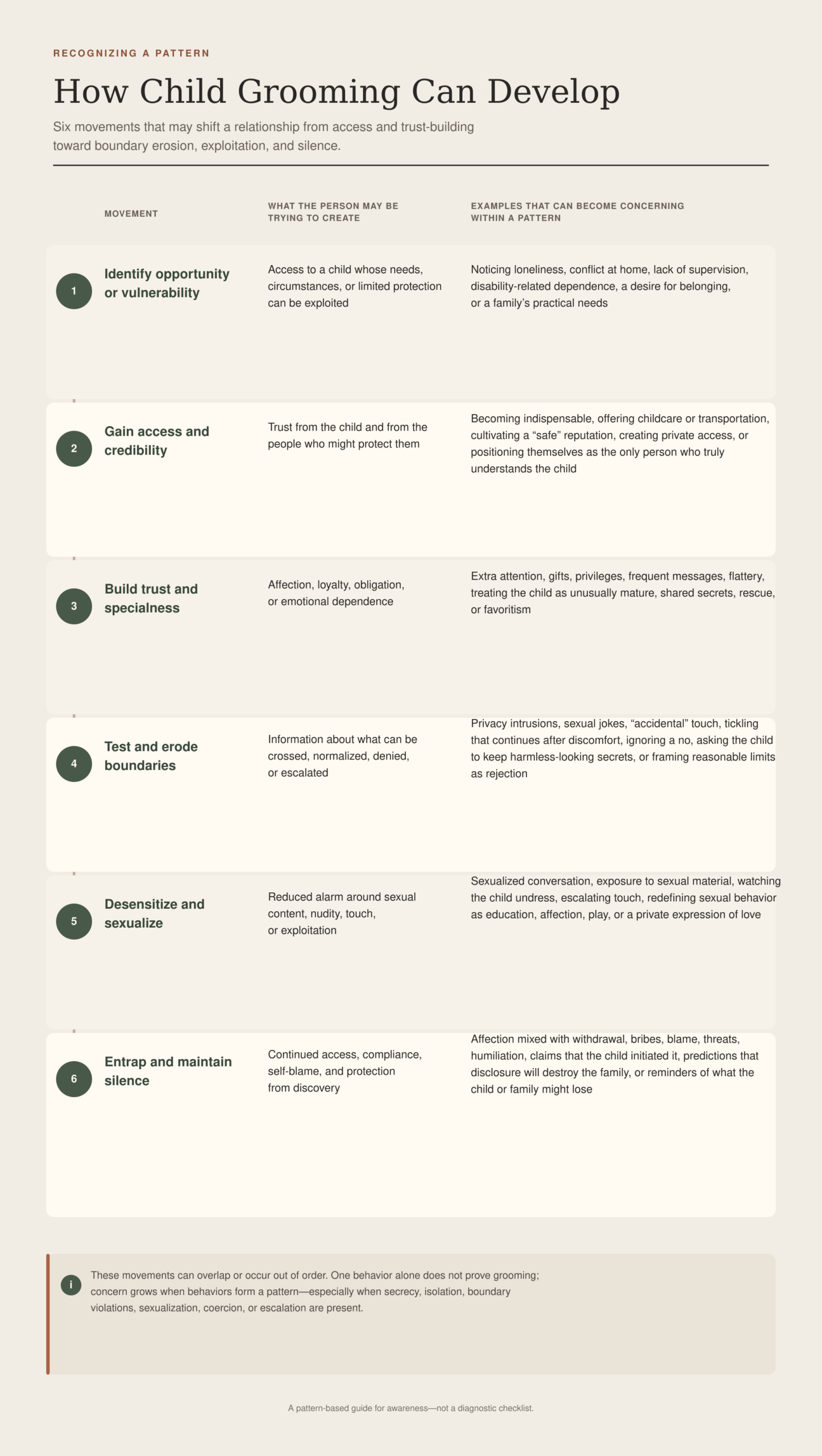
The first movement is often called “victim selection” in the research. That term describes an offender’s process; it does not mean a child caused their selection by being lonely, trusting, disabled, unsupervised, curious, affectionate, or in need. A vulnerability is an unmet protection need or a circumstance an offender exploits; not a defect in the child.
How Sexual Grooming Gradually Escalates
Popular stories portray abuse as one dramatic event: danger appears, the child recognizes it, and a clear decision follows. Grooming can work more like a staircase built one shallow step at a time. The early steps may feel good. Someone notices you. Listens to you. Helps your family. Makes you feel chosen. The next step is only slightly different from the last, and each crossed boundary is explained away before the next one appears.
By the time the behavior is unmistakably abusive, the child may be carrying attachment, fear, secrecy, gratitude, shame, practical dependence, and concern for the entire family. Entrapment is not only the locked door. It is the carefully constructed belief that every available door leads to a worse danger.
Grooming can also surround the child. A person may charm caregivers, volunteer in respected roles, appear exceptionally generous, or make themselves valuable to an organization. When someone raises a concern, the community may defend the reputation it was trained to trust. This is one reason “But everyone loved them” is not evidence of safety. Sometimes being widely trusted is what created the access.
Common Myths About Sexual Grooming
Myth: Grooming always begins with sexual behavior
What we know: Grooming may begin with ordinary-looking care, attention, practical help, shared interests, or family trust. Sexualization and obvious boundary violations may appear later. This does not make kindness suspicious by default. Healthy adults welcome transparency, respect a child’s no, accept supervision, and do not need secrecy or special access to maintain the relationship.
Myth: The danger is usually a stranger
What we know: The CDC reports that about 90% of child sexual abuse is committed by someone known and trusted by the child or the child’s family. In incest and other intra-familial abuse, access and trust are often built into the relationship before deliberate grooming tactics begin. “Stranger danger” is an incomplete safety lesson. Children also need permission to have boundaries with relatives, caregivers, teachers, coaches, spiritual leaders, older youth, and every other familiar person.
Myth: If a child accepted gifts, returned, protected the person, or felt special, they participated in the abuse
What we know: Attachment and manipulation can exist at the same time. A child may love the person who harms them, depend on them, enjoy the non-abusive attention, fear losing them, or worry about what disclosure will do to the family. None of those reactions creates informed consent. A child’s body may also respond automatically during abuse. A physical response is physiology, not permission.
Myth: A child who was truly uncomfortable would say no, leave, or tell
What we know: Children may not understand that the behavior is abusive, may lack words for it, or may expect disbelief, punishment, family separation, retaliation, or the loss of someone they love. The CSA Centre’s research summary on disclosure describes disclosure as a process that may be partial, indirect, nonverbal, delayed, or extended over time. Silence does not tell us that nothing happened. It may tell us that speaking did not feel possible or safe.
Myth: Every gift, secret, hug, or special relationship is grooming
What we know: Many individual behaviors associated with grooming also occur in healthy relationships. A checklist cannot read another person’s mind. Concern increases when behaviors form a pattern around secrecy, isolation, sexualization, private access, escalating boundary violations, retaliation, or refusal to accept limits. The safest response is to notice observable conduct, strengthen transparent boundaries, and seek qualified help when there is a concern; not to make a public accusation from one ambiguous interaction.
Myth: Grooming follows the same order in every case
What we know: Models organize common patterns; people do not live inside diagrams. Stages may overlap, repeat, accelerate, reverse, or be absent. Online grooming can differ from in-person grooming. Grooming by a family member with automatic access can differ from grooming by an outsider. The adult-focused model discussed here should not be automatically applied to sexual behavior between children without considering age, development, coercion, power, and context.
Myth: No force means no coercion
What we know: Force is only one form of control. Deception, dependency, authority, secrecy, affection, threats, rewards, role expectations, and gradual normalization can constrain a child’s choices without visible violence. The absence of a fight is not the presence of freedom.
Myth: If a survivor cannot remember the sequence perfectly, the pattern is meaningless
What we know: A survivor does not need to reconstruct a textbook progression to deserve care. At the same time, no sequence model can prove specific events from symptoms, impressions, or fragments alone. The ethical position is neither automatic disbelief nor manufactured certainty. It is careful listening, respect for what is known and unknown, attention to present safety, and appropriate professional support.
How Sexual Grooming Affects Survivors
Learning about grooming can produce relief and grief in the same breath. Relief may come from finally seeing that what looked like “my choices” happened inside conditions someone else shaped. Grief may come from realizing that attention you treasured, trust you offered, or loyalty you protected was used against you.
Both responses make sense.
If grooming was part of your experience, you may recognize lasting adaptations such as:
- doubting discomfort until you can prove someone meant harm;
- feeling guilty when a boundary disappoints another person;
- confusing intensity, rescue, or being chosen with safety;
- freezing, appeasing, disconnecting, or going blank when limits are crossed;
- expecting affection to create debt;
- feeling responsible for protecting a harmful person or holding a family together;
- mistrusting your own perception because violations were repeatedly renamed as love, play, care, education, or your fault.
These patterns are possibilities, not a diagnosis. They can also develop for other reasons, and not every survivor experiences them. Child sexual abuse is associated with long-term mental and physical health consequences. The CDC identifies increased risks that include depression, post-traumatic stress symptoms, substance misuse, suicidal behavior, some chronic physical conditions, relationship difficulties, and later victimization. These are population-level associations; not destiny, not proof that one experience caused a particular condition, and certainly not evidence of damage beyond repair. Many survivors heal, build safe relationships, and experience meaningful lives, especially when they receive steady support and appropriate care.
A Gentler Question for Survivors of Grooming
“Why didn’t I stop it?” asks the child to explain an adult’s abuse. Try asking: What trust, dependence, fear, confusion, boundary erosion, or threatened loss made resistance and disclosure harder? That question does not erase agency. It places agency in its proper context. Healing is not pretending we had choices that were unavailable then. Healing is noticing the choices that are becoming available now.
Optional Grooming Pattern-Mapping Exercise
This is not a memory-recovery exercise and should not be used to fill gaps, force certainty, or prove abuse. If it feels grounding, not overwhelming, you might write brief answers to these questions:
- What observable boundary was crossed or made unclear?
- What did I believe might happen if I objected, left, or told?
- What role was I expected to play: special one, secret keeper, caretaker, peacemaker, mature child, or family protector?
- What belief about love, safety, obligation, or my body did I carry forward?
- What present-day boundary, support, or choice would return one small piece of power to me?
You do not need to finish the page. You do not need to excavate every room in the house to prove there was a fire.
How Partners Can Support Survivors of Sexual Grooming
A partner cannot undo grooming by taking control in the opposite direction. Survivors need safety, but safety without agency can begin to feel like another cage.
Support usually looks less like solving the past and more like becoming trustworthy in the present:
- Believe without interrogating. You can take a survivor seriously without demanding a courtroom-ready timeline.
- Do not confuse complexity with dishonesty. Love, loyalty, anger, grief, disgust, longing, and relief can coexist.
- Ask before advising or touching. “Would you like comfort, help thinking, or space?” restores choice.
- Respect small boundaries. A trustworthy response to “not now” is one of the clearest ways to teach the nervous system that a limit no longer threatens the relationship.
- Do not demand estrangement, confrontation, forgiveness, or disclosure. Discuss current safety honestly, but do not seize the survivor’s decisions.
- Choose steadiness over intensity. Consistency, repair, and transparency usually communicate more safety than dramatic promises.
- Maintain your own healthy boundaries. Support does not require becoming a therapist, accepting harm, or abandoning your needs.
Helpful language can be simple:
- “What happened was not your fault.”
- “You do not have to make the story neat for me.”
- “It makes sense that your feelings about them are complicated.”
- “What would help you feel more choice right now?”
- “I can care about you and still be honest about my limits.”
Try to avoid questions that quietly place responsibility back on the child, such as “Why did you keep going back?” or “Why didn’t you tell your mother?” A more useful question is, “What did the person or the family system make you believe would happen if you told?” If there is current contact with an alleged abuser, access to children, stalking, threats, or other immediate risk, compassion should be paired with qualified safety support. Do not investigate or confront a suspected offender on your own when doing so could increase danger or compromise a formal investigation.
Clinical Considerations for Therapists Supporting Grooming Survivors
The grooming framework can reduce shame, clarify coercion, and support case formulation. It can also cause harm when it is used as a certainty machine. Clinical care requires both survivor validation and disciplined humility.
Distinguish Grooming Behaviors, Patterns, and Inferred Intent
Document what was observed or reported before interpreting the motive. “The adult sent private messages after the child’s caregiver prohibited contact” is an observable behavior. “The adult was grooming the child” is a conclusion requiring broader context. This distinction does not require minimizing risk. It protects careful thinking and supports appropriate consultation, safeguarding, and forensic processes.
Do Not Use Grooming Stages as a Diagnostic Checklist
Absence of a stage does not rule out abuse. Presence of a familiar behavior does not prove sexual intent. Explore the pattern, power differential, secrecy, isolation, escalation, sexualization, consequences of resistance, and surrounding family or institutional dynamics. The five-stage model discussed in this article was developed for in-person sexual grooming of children. Apply caution when considering online abuse, adult relationships, trafficking, sibling sexual abuse, abuse by another youth, or culturally specific family structures.
Treat Child Sexual Abuse Disclosure as a Process
The CSA Centre’s evidence review notes that disclosures may be indirect, partial, nonverbal, delayed, or withdrawn. Avoid equating a polished chronological account with truth or an incomplete account with deception. Listen without shock or blame. Avoid pushing for details that are unnecessary for the therapeutic purpose. Therapists who are not conducting a formal forensic interview should not drift into one. Follow applicable reporting duties, documentation standards, and referral procedures.
Create a Therapeutic Relationship That Does Not Repeat Grooming
Grooming exploits trust, secrecy, specialness, dependency, and gradually crossed limits. Therapy should make boundaries visible.
That includes:
- transparent roles and limits;
- clear discussion of confidentiality and its exceptions;
- meaningful consent and permission to pause;
- collaboration on goals and pacing;
- predictable contact policies;
- careful management of gifts, self-disclosure, touch, dual relationships, and between-session communication;
- repair when the client experiences a boundary rupture;
- consultation when rescue fantasies, exceptionalism, secrecy, or dependency begin shaping the work.
These practices align with trauma-informed principles of safety, trustworthiness, collaboration, empowerment, voice, and choice.
Expect Complex Attachment to an Abuser
Do not treat affection for an abuser as evidence against abuse. Explore what the relationship provided alongside what it cost. Grief may concern not only what happened, but also the care the survivor thought they had, the family they needed, or the future they were promised. Psychoeducation should relieve blame without prescribing what the survivor must feel. Anger is not the only credible response. Neither is forgiveness.
Assess Current Safety Without Reenacting Control
Ask about current contact, access to children or other vulnerable people, threats, coercive monitoring, housing and financial dependence, retaliation risk, and the survivor’s support network. When a child or vulnerable person may be at risk, follow the law and professional standards in the relevant jurisdiction. Mandated-reporting rules vary, so verify them rather than relying on general internet guidance.
Be honest early about actions you may be required to take. Whenever possible, explain what will happen next, why, and how the client can remain involved. Transparency cannot remove every loss of control, but secrecy from the clinician can repeat the architecture of the original harm.
Hold uncertainty ethically
Symptoms alone cannot establish that grooming or abuse occurred. Do not suggest missing events, pressure memory retrieval, or present an interpretation as recovered fact. It is possible to say, “Your distress and confusion deserve care,” while remaining accurate about what is remembered, documented, inferred, disputed, or unknown.
Understanding Sexual Grooming Without Blaming Survivors
Grooming hides abuse inside trust.
That is what makes it so difficult to recognize. The kindness may have been real to the child even when the adult’s use of it was exploitative. The attachment may have been real. The dependence may have been real. The threatened losses may have been painfully real.
None of that makes the child responsible.
If grooming was part of your story, you were not foolish for trusting someone who occupied a trusted role. You were not consenting because you felt special. You were not complicit because you stayed close, kept a secret, froze, appeased, returned, cared, or could not name what was happening. The responsibility belongs to the person who used greater power, access, knowledge, authority, or developmental advantage to create the conditions for abuse. Naming the sequence does not force your life into six boxes. It simply turns on a light. It helps us see that what once looked like a child’s failure may have been an adult’s construction.
And once we can see the construction, we can begin dismantling what it taught us:
- attention is not ownership;
- affection does not create debt;
- secrecy is not intimacy;
- familiarity is not safety;
- compliance is not consent;
- and a boundary does not make you cruel.
One next step
Continue with Mechanisms of Entrapment & Control to see how grooming connects with secrecy, dependency, gaslighting, threat-reward cycles, and coercive control.
Reflection prompts
- Which myth about grooming has shaped the way I judge myself or another survivor?
- What is one boundary I want to practice believing before I can perfectly justify it?
- What would trustworthy care look like if it did not require secrecy, debt, fear, or self-abandonment?
Related Holey House articles
- Mechanisms of Entrapment & Control
- Forms of Sexual & Relational Abuse
- Family Systems & Collusion
Research & Further Reading
Winters, G. M., Jeglic, E. L., & Kaylor, L. E. (2020). Validation of the Sexual Grooming Model of Child Sexual Abusers. Journal of Child Sexual Abuse, 29(7), 855–875.
Australian Government, National Office for Child Safety. Grooming.
Centers for Disease Control and Prevention. About Child Sexual Abuse.
Centre of Expertise on Child Sexual Abuse. Key Messages from Research on Identifying and Responding to Disclosures of Child Sexual Abuse.
Centre of Expertise on Child Sexual Abuse. Key Messages from Research on Intra-Familial Child Sexual Abuse.
National Child Traumatic Stress Network. Child Sexual Abuse Fact Sheet for Parents, Teachers, and Other Caregivers.
Substance Abuse and Mental Health Services Administration. Trauma-Informed Approaches and Programs.
Sexual Abuse Support and Safety Resources
This article is educational and is not therapy, diagnosis, legal advice, or a substitute for care from a qualified professional. I am a trauma survivor and educator, not a licensed mental health professional.
If a child may be in immediate danger, contact local emergency services or the appropriate child-protection authority. In the United States and Canada, the Childhelp National Child Abuse Hotline is available 24/7 by call or text at 800-422-4453. In the United States, RAINN’s National Sexual Assault Hotline offers free, confidential 24/7 support at 800-656-HOPE (4673), by online chat, or by texting HOPE to 64673. For suicidal crisis or emotional distress in the United States and its territories, call or text 988 or visit the 988 Lifeline. If you are elsewhere, contact local emergency, sexual-assault, or child-protection services.

0 Comments