


How Boundary Testing Can Normalize Abuse, Erode Self-Trust, and Entrap Survivors
Content note: This article discusses incest, grooming, child sexual abuse, coercive control, privacy intrusions, and trauma responses. Read at your own pace. You are allowed to pause before your mind has finished the paragraph.
Graduated Boundary Violations: Key Takeaways
A graduated boundary violation is a plain-language way to describe a pattern in which small intrusions are followed by larger ones. The person may test what will be noticed, what will be tolerated, how resistance is handled, and whether the intrusion can be renamed as love, play, concern, family privilege, or “no big deal.” Over time, the boundary moves while the survivor is taught to doubt that it ever existed.
This phrase is not a diagnosis, legal definition, or scientifically validated sequence. Research most clearly documents gradual sexualization, boundary-violating behavior, and other grooming tactics in child sexual abuse. The same lens may help people think about coercive adult, family, institutional, or helping relationships, but those contexts should not be treated as identical.
One awkward interaction does not prove abusive intent. Concern increases when an intrusion is repeated or escalated, occurs across a power difference, creates secrecy or dependency, becomes sexualized, or brings punishment when a limit is expressed. A person’s response to a boundary often tells us more than their explanation for crossing it.
Most important: surviving the early steps did not authorize the later breach. Not recognizing a gradual pattern while you were living inside it does not make you responsible for what someone else chose to do.
What Graduated Boundary Violations in Grooming and Abuse Really Mean
For a long time, I thought a boundary violation had to arrive wearing a name tag. I expected danger to be obvious, resistance to be immediate, and my certainty to be clean. If I could not point to the exact moment when “uncomfortable” became “wrong,” I assumed the problem was my perception. That belief kept the final breach in focus while erasing all the smaller moments that had trained me not to trust myself. Part of waking from what I call my Trauma Coma has been learning that abuse does not always begin with its most recognizable act. Sometimes the line is not smashed in one dramatic moment. It is nudged, blurred, joked over, apologized around, and moved again. In this article, graduated boundary violation means a pattern of progressively greater intrusion. It may involve privacy, touch, emotional access, sexual content, time, money, communication, caregiving, spiritual authority, or control over personal decisions. The pattern matters because each smaller crossing can create information for the person with more power:
- What will this person tolerate?
- Will anyone intervene?
- Can discomfort be turned into guilt?
- What happens when they say no?
The Australian National Office for Child Safety explains that grooming behaviors may look nonsexual, resemble behavior found in non-abusive relationships, and become recognizable only in hindsight. It also describes gradual sexualization, normalization, secrecy, shame, blame, coercion, and threats as tactics that can facilitate or maintain child sexual abuse.
A 2020 study by Winters, Jeglic, and Kaylor examined a five-stage model of in-person sexual grooming: victim selection; gaining access and isolation; trust development; desensitization to sexual content and physical contact; and post-abuse maintenance. The study is useful, but exploratory. It does not establish one universal sequence or allow us to infer sexual intent from a single behavior.
More recent research has also treated boundary-violating behaviors as a distinct prevention concern in youth-serving organizations. A national retrospective study by Assini-Meytin and colleagues examined sexual abuse and boundary-violating behaviors across schools, organized sports, religious organizations, arts programs, and other youth settings. That organizational research cannot be automatically generalized to incest, adult intimate relationships, or every private interaction. It does support a careful distinction: subtle boundary violations deserve attention even when they are not, by themselves, proof of sexual abuse.
Boundary Crossing, Boundary Violation, and Grooming Are Not Identical
These terms are sometimes used differently across clinical, organizational, and everyday settings. For this article, the following distinctions are practical rather than diagnostic:

Not every crossing is grooming. Not every abusive act requires grooming. A person can also violate boundaries through entitlement, carelessness, poor role clarity, or learned family norms without following a calculated plan.
Intent still matters when determining accountability, risk, or legal responsibility. But you do not need to prove another person’s private motive before deciding that an observable behavior is unsafe, unwanted, or incompatible with access to you.
The Boundary-Erosion Pattern: A Holey House Teaching Map
The following map translates research on grooming, desensitization, and boundary-violating behavior into a survivor-centered sequence. It is not a validated stage model, a diagnostic checklist, or proof that any specific person intended abuse. Real patterns may skip steps, repeat them, happen quickly, or unfold over years.
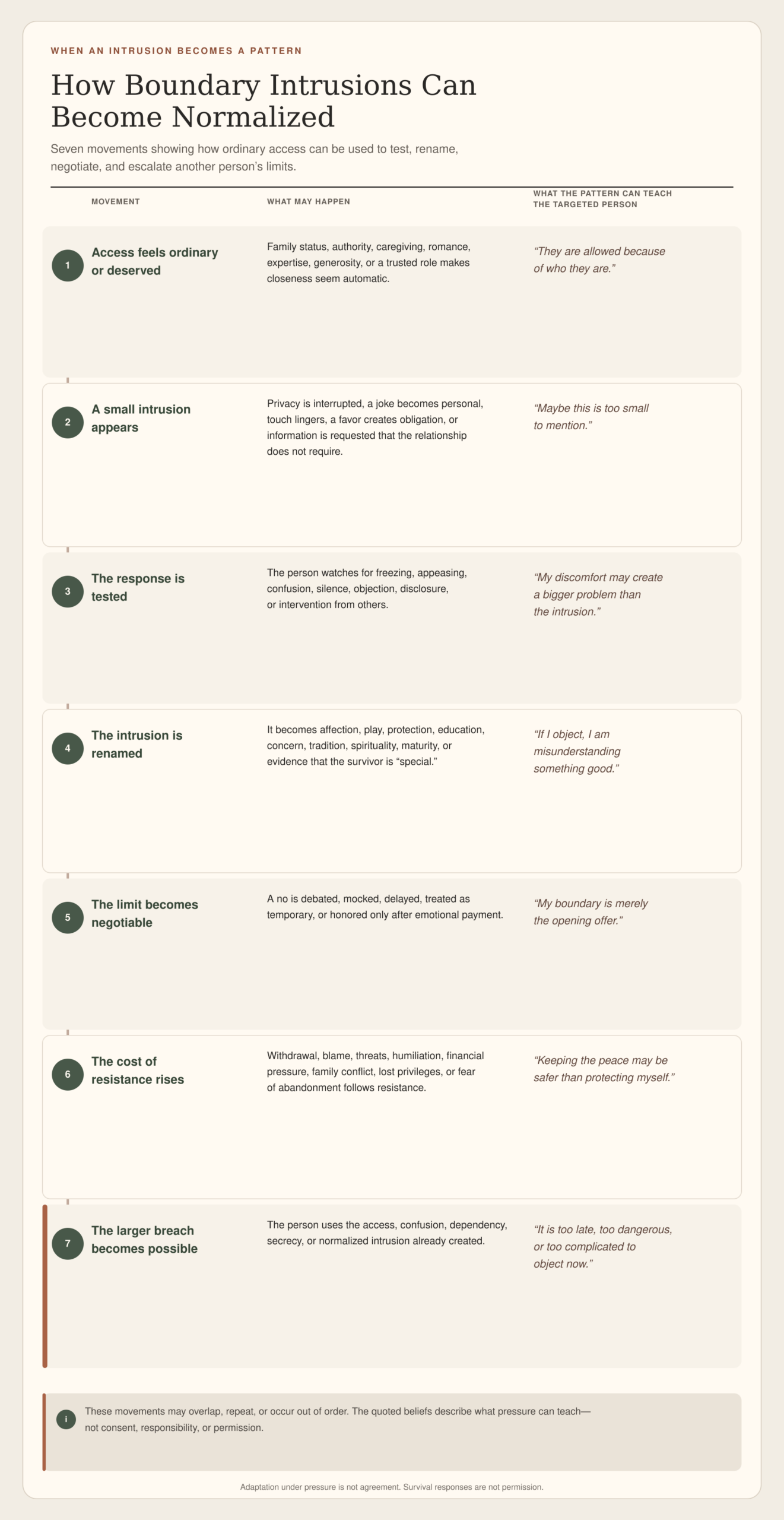
This pattern can be especially difficult to identify within incest because family members may already have access, authority, affection, trust, and private time. An abusive relative may not need to create closeness from nothing. They may exploit a relationship the child has been taught to obey and protect.
Why Tiny Boundary Intrusions Can Be So Powerful
A tiny intrusion is not powerful because the survivor is weak. It is powerful because human beings understand behavior through context. If an action is only slightly different from what came before, alarm can remain uncertain. If the person is loved, depended upon, admired, feared, or responsible for your care, the mind has more than one truth to hold. “This feels wrong” may have to compete with “They love me,” “They help our family,” “Everyone trusts them,” or “I will be blamed if I make trouble.”
The person crossing the boundary may also provide the interpretation before the survivor can form one:
- “I was only joking.”
- “You know I would never hurt you.”
- “This is what close families do.”
- “You are mature enough to understand.”
- “After everything I have done for you?”
- “You said yes last time.”
- “Do not make this ugly.”
Repeated renaming can weaken confidence in internal signals. The survivor may learn to wait for undeniable evidence, a witness, a confession, or permission from someone else before treating discomfort as meaningful. That does not mean every uneasy feeling is proof of danger. Feelings are information, not verdicts. They can invite a pause, a question, a limit, more observation, or support. We do not have to put our nervous system on the witness stand and demand that it prove the entire case before we lock a door.
The Response to a Boundary Is Part of the Evidence
A respectful person can misread a situation, forget a preference, or make a mistake. The difference is not perfection. The difference is what happens after impact becomes clear.
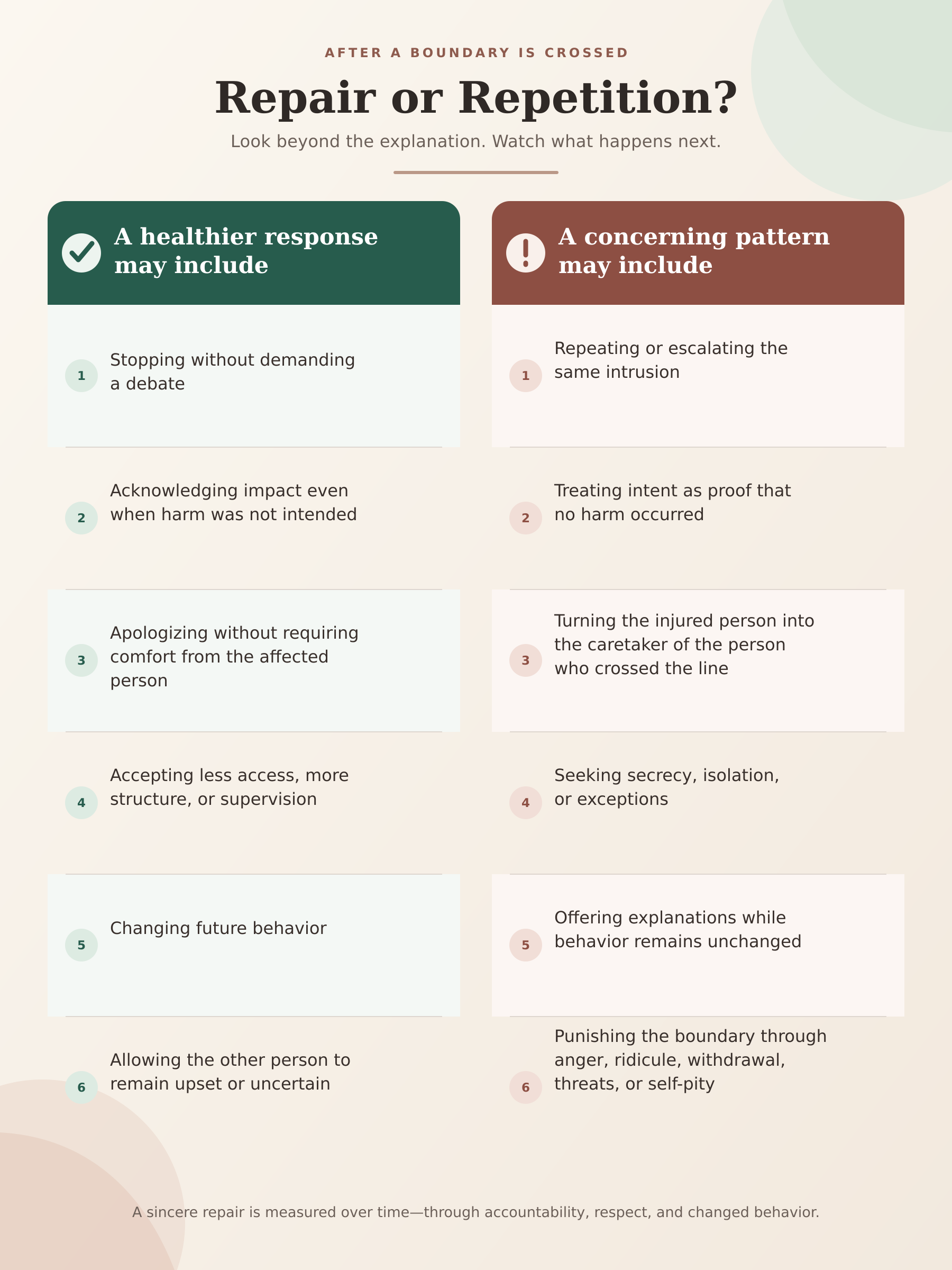
This table is not a lie detector. Some abusive people can apologize convincingly, and some safe people become defensive before they calm down and repair. Look at the pattern over time: Does the behavior change? Does your freedom increase? Does “no” become safer or more expensive?
Common Myths About Gradual Boundary Violations
Myth: Major Abuse Always Looks Dangerous From the Beginning
What we know: Grooming can begin with trust, attention, help, shared secrets, or ordinary-looking access. The National Office for Child Safety notes that grooming behaviors may be nonsexual and difficult to identify outside the broader pattern. Early experiences may even feel comforting. That is not evidence that later abuse was chosen. It is evidence that connection and exploitation can become tangled together.
Myth: One Small Boundary Crossing Proves Someone Is an Abuser
What we know: A single ambiguous behavior cannot establish motive or a complete pattern. Context matters: the relationship, power difference, type of access, response to feedback, secrecy, repetition, escalation, sexualization, and consequences of resistance. Taking a small intrusion seriously does not require making the largest possible accusation. It may mean naming the behavior, adding supervision, documenting an organizational concern, reducing access, consulting a qualified professional, or watching whether the person respects the limit.
Myth: If the First Intrusion Was Small, the Survivor Overreacted
What we know: People are allowed to set limits before harm becomes catastrophic. A boundary does not need a dramatic injury to become valid. In prevention, waiting for certainty can mean waiting for escalation. A proportionate response might be as simple as, “Do not enter without knocking,” “No private messages,” “Do not touch me there,” or “That topic is not appropriate for this relationship.”
Myth: If You Did Not Say No, No Boundary Was Crossed
What we know: Silence can reflect uncertainty, developmental limits, freezing, appeasing, fear, dependency, lack of language, or a realistic expectation that resistance will be punished. A child cannot provide informed consent to sexual activity with an adult. The CDC’s definition of child sexual abuse explicitly recognizes that a child may not fully comprehend the activity and cannot or does not give informed consent. In adult relationships, consent must still be voluntary, specific, and present. The absence of a spoken no does not automatically establish freely given agreement.
Myth: Agreeing Once Removes the Right to Refuse Later
What we know: Permission is not a lifetime membership card. A person may change their mind, limit the scope, ask to pause, or withdraw consent. An earlier yes does not authorize a different act, a more intense act, a later act, or continued access after consent changes.
Myth: Boundary Violations Are Only Physical or Sexual
What we know: Boundaries can involve privacy, communication, emotional disclosure, money, time, caregiving, technology, spiritual authority, medical decisions, work roles, and family access. These are not all equally severe, and they should not be collapsed into sexual abuse. They can still become part of a coercive environment when one person repeatedly overrides another’s autonomy.
Myth: Good Intentions Cancel Harm
What we know: Intent and impact answer different questions. Intent helps us understand why something happened. Impact helps us understand what it did. A trustworthy person can say, “That was not what I meant, and I see that it affected you. I will change it.” An entitled person often treats their intention as a veto over your reality.
Myth: Stronger Boundaries Would Have Prevented the Abuse
What we know: Responsibility belongs to the person who chose to exploit power or disregard consent. Children cannot be assigned responsibility for managing adult behavior. Adults facing coercion may also be constrained by money, housing, immigration status, disability, caregiving, threats, isolation, love, or danger. Boundary skills can support present-day safety. They are not retroactive proof that the survivor could have prevented the past.
Myth: Forgiveness Requires Restored Access
What we know: Forgiveness is personal, spiritual, cultural, and sometimes unwanted. It is not the same as trust, reconciliation, contact, or unsupervised access. A person can release resentment and keep the door locked. A person can remain angry and still heal. No emotional position entitles someone else to renewed access.
Myth: Understanding the Pattern Proves Every Detail of the Past
What we know: A framework can help organize known experiences, but it cannot manufacture evidence, recover missing events, or diagnose another person. Symptoms and present-day reactions do not prove a specific history by themselves. The ethical middle ground is possible: survivors deserve care without being pushed toward certainty they do not have.
How Graduated Boundary Violations Affect Survivors
When boundaries were moved gradually, a survivor may not only remember the final violation. They may carry the training that surrounds it.
That training can sound like:
- I need a perfect reason before I can say no.
- Discomfort is rude unless I can prove danger.
- Love means giving access.
- Privacy is selfish.
- Someone else’s disappointment is an emergency.
- A limit is not real until the other person agrees with it.
- If I did not object immediately, I surrendered the right to object later.
These beliefs are possible adaptations, not diagnoses. They may come from many experiences, and not every survivor will recognize them.
Why Survivors May Notice a Boundary Late
Delayed recognition is often treated as evidence that the boundary did not matter. Sometimes it means the person finally had enough distance, language, safety, or comparison to understand what happened. The body may register an intrusion before the mind can explain it. A survivor might become foggy, nauseated, numb, restless, suddenly agreeable, or desperate to leave. Those reactions are not proof of another person’s intent. They are still worthy of curiosity.
I have had to learn that clarity does not always arrive on schedule. Sometimes it walks in three days later, sets its purse on the table, and says, “Now that we are safe, can we talk about what just happened?” Late clarity is still clarity.
Long-Term Mental and Physical Health Relevance
Child sexual abuse is associated with increased risks for long-term mental, physical, behavioral, and relational difficulties. The CDC identifies associations that include depression, post-traumatic stress symptoms, substance misuse, suicidal behavior, later victimization, and some chronic physical health conditions.
These are population-level associations. They do not mean every survivor will develop these conditions, and they do not prove that one experience caused any individual diagnosis. Health is shaped by many interacting factors, including other adversities, genetics, environment, discrimination, resources, relationships, and access to care.
Understanding graduated boundary violations may help explain one relational pathway through which trauma persists: when a person learns that internal warning signals will be mocked, ignored, or punished, future safety decisions can become harder. That is an informed interpretation; not a claim that boundary erosion alone causes a specific mental or physical illness. Healing remains possible. Safe relationships, steady support, effective trauma treatment, practical resources, and restored autonomy can all matter. A risk is not a prophecy.
Rebuilding Boundary Trust Without Blaming Yourself
Healing does not require becoming suspicious of everyone or building a moat around the house. It may begin with giving yourself permission to notice earlier. Try replacing “Am I allowed to have this boundary?” with:
What limit would protect my safety, dignity, energy, privacy, or freedom of choice here?
A present-day boundary can be valid even when:
- you cannot explain it perfectly
- the other person disagrees
- you allowed something similar before
- your feelings are mixed
- the person meant well
- the relationship is important
- you need time before deciding what happens next
Optional Exercise: Map the Boundary, Not a Missing Memory
This exercise is for present-day clarity. It is not memory recovery, proof of abuse, or a demand to confront anyone. Stop if it increases distress or makes you feel less grounded. Choose one current, lower-risk situation and write:
- The observable behavior: What happened without guessing their motive?
- My signal: What did I notice in my body, emotions, thoughts, or urge to act?
- My preference or limit: What do I want more of, less of, or none of?
- The safest expression: Is it safer to say it directly, write it, add structure, reduce access, ask for support, or leave without a debate?
- The response: Did the person stop, repair, negotiate respectfully, minimize, repeat, retaliate, or escalate?
- My next protection: What action is within my control now?
If the person is controlling, violent, stalking, monitoring devices, threatening housing or money, or likely to retaliate, direct confrontation may increase danger. A safety plan with a qualified local advocate may be more appropriate than a boundary conversation. You do not have to practice your newest no on the person most committed to defeating it.
How Partners Can Support Survivors With Boundary Trust
A partner cannot heal boundary erosion by becoming the survivor’s new authority. Protection that removes choice can feel alarmingly similar to control, even when it arrives with good intentions and a color-coded plan. The goal is not to force confidence. It is to make honesty, uncertainty, and refusal safer inside the relationship.
Make “No” Less Expensive
One of the most reparative things a partner can do is accept an ordinary limit without turning it into a crisis. If “not tonight,” “please knock,” “I need space,” or “do not share that” leads to sulking, interrogation, accusations, or withdrawal, the survivor learns that the price of a boundary is still relational danger.
A steadier response might be:
- “Okay. Thank you for telling me.”
- “Do you want an alternative, or should we leave it there?”
- “You do not have to convince me.”
- “I am disappointed, but I can handle my feelings without punishing you.”
Ask Before Touching, Advising, or Taking Over
Choice can be restored in small moments:
- “Would touch feel comforting right now?”
- “Do you want me to listen, help you think, or help you act?”
- “May I share what I noticed?”
- “Would you like company or privacy?”
These questions are not a script that partners must perform perfectly. They are a habit of remembering that closeness does not erase autonomy.
Repair a Misstep Without Making Intent the Main Character
You will cross a preference, misunderstand a cue, or get something wrong. Healthy relationships are not boundary museums where nobody touches anything. They are places where impact can be named and repair can occur. Try: “I understand that I crossed a line. I am sorry. I will change that behavior. Is there any practical repair you want from me?” Avoid requiring the survivor to reassure you that you are not like the person who harmed them. Your guilt should not become another room they must clean.
Do Not Demand a Perfect Trauma Narrative
Graduated violations can leave memories emotionally vivid but chronologically untidy. Take the survivor seriously without cross-examining them, filling gaps, or announcing conclusions beyond what they know.
You can say:
- “You do not have to make the story neat for me.”
- “It makes sense that you understood it differently then.”
- “We can hold what you know and what you do not know.”
- “Your present boundary does not depend on proving the past to me.”
Keep Your Own Boundaries Visible
Supporting a survivor does not require accepting cruelty, becoming a therapist, abandoning privacy, or making yourself endlessly available. Mutual boundaries help distinguish safe partnership from rescue and dependency. Name your limit without using it as punishment: “I care about you, and I cannot continue this conversation while we are yelling. I can return to it at seven.” Consistency matters. A boundary that disappears whenever guilt enters the room becomes difficult for both people to trust.
Respond to Current Risk With Care and Humility
If there is current abuse, stalking, sexual coercion, threats, access to children, or fear of retaliation, do not rush into confrontation with the suspected person. Ask what the survivor believes would increase or reduce danger. Seek qualified advocacy, clinical consultation, or emergency help appropriate to the situation. Support without rescuing means standing beside someone while respecting that they are the expert on the terrain they have had to survive.
Therapist Considerations for Graduated Boundary Violations
The concept of graduated boundary violation can help clients name escalation, self-doubt, and the rising cost of resistance. It can also become harmful if a therapist uses it to diagnose an absent person, impose a sequence on uncertain memories, or treat every uncomfortable interaction as covert grooming. Clinical usefulness depends on precision and humility.
Define the Concept Before Applying It
Tell clients that “graduated boundary violation” is a descriptive teaching phrase, not a DSM diagnosis, forensic conclusion, or validated assessment model. Clarify that the strongest related research concerns sexual grooming and boundary-violating behaviors in child and youth contexts. When the client is describing adult relationships, family systems, institutions, spiritual communities, or prior therapy, use the lens as a hypothesis about observable dynamics; not a claim that all contexts function the same way.
Separate Behavior, Impact, Pattern, and Inferred Intent
Document what was reported before interpreting it.
- Behavior: “The adult entered the child’s room after being asked to knock.”
- Impact: “The client recalls fear, freezing, and loss of privacy.”
- Pattern: “The behavior repeated and escalated after objections.”
- Inferred intent: “The client believes the intrusions were used to increase sexual access.”
All four may matter, but they are not interchangeable. This separation supports accurate records, careful formulation, appropriate safeguarding, and ethical uncertainty.
Assess the Cost of Resistance
Do not ask only, “Did the client say no?” Explore what no was expected to cost. Relevant questions may include:
- What power did the other person hold?
- What happened after discomfort or resistance?
- Was the behavior repeated, escalated, hidden, sexualized, or defended as normal?
- Did the client risk losing housing, care, money, community, faith, affection, family stability, or physical safety?
- Were disability, age, immigration status, race, gender, sexuality, or cultural expectations used to increase dependency or silence?
- What did surrounding adults or institutions notice, permit, dismiss, or punish?
These questions help contextualize behavior without turning the therapist into an investigator.
Treat Nervous-System Responses as Information, Not Proof
Freezing, appeasing, dissociation, panic, numbness, somatic distress, or delayed clarity may be clinically meaningful. They do not independently establish another person’s motive or prove a specific past event. Therapy can honor the response without forcing a conclusion: “Something about that interaction registered as unsafe or overwhelming. Let us understand what you noticed and what you need now.” Avoid suggestive memory work, pressure to retrieve a complete sequence, or confidence that exceeds the client’s evidence. Care does not require counterfeit certainty.
Make the Therapeutic Frame the Opposite of Gradual Erosion
Therapy contains an unavoidable power difference. Boundaries should therefore become more visible, not less visible, as trust develops. Helpful practices include:
- explaining confidentiality and its limits before sensitive disclosure;
- using ongoing, meaningful consent for interventions;
- inviting pauses and disagreement without relational punishment;
- clarifying policies for contact, emergencies, fees, records, gifts, touch, self-disclosure, social media, and termination;
- avoiding secrecy, exceptionalism, role confusion, and unnecessary dependency;
- monitoring countertransference, rescue fantasies, specialness, and the wish to be the one indispensable helper;
- consulting when the frame begins to shift;
- acknowledging and repairing boundary ruptures instead of defending professional intent.
These practices align with SAMHSA’s trauma-informed principles, including safety, trustworthiness, collaboration, empowerment, voice, and choice. Clinicians should also follow the current ethics code and scope requirements of their own profession. For psychologists, the APA Ethics Code addresses multiple relationships, exploitation, and sexual relationships with clients.
Avoid Boundary Absolutism
Not every flexible boundary is harmful, and not every rigid boundary is safe. Cultural norms, disability access, community context, treatment setting, and clinical necessity can shape appropriate practices. The useful questions are not merely, “Was the standard frame altered?” but:
- Whose need did the alteration serve?
- Was there informed discussion?
- Could the client decline without losing care or approval?
- Did the change increase exploitation risk, role confusion, secrecy, or dependency?
- Was the decision documented and, when appropriate, consulted upon?
Clear reasoning is more protective than pretending every relationship can be governed by one universal list.
Practice Boundary Repair, Not Boundary Performance
Some survivors expect every misattunement to be denied because denial was part of the original pattern. A clinician who can hear impact, remain regulated, apologize accurately, and change behavior offers a different relational experience. Repair does not mean agreeing with every interpretation. It means taking the rupture seriously, examining power, and refusing to punish the client for naming what happened between you.
Address Current Safety and Reporting Duties Transparently
Assess present contact, threats, stalking, coercion, access to children or vulnerable people, financial and housing dependence, device monitoring, and the risks of confrontation. If suspected abuse of a current child or another protected person is disclosed, reporting duties depend on profession and jurisdiction. The Child Welfare Information Gateway provides a general overview of U.S. state laws, but clinicians should verify current local statutes, licensing rules, agency policy, and consultation requirements rather than relying on a general article. Whenever possible, explain reporting limits early and tell the client what will happen next. A required action may still feel like a loss of control; secrecy from the clinician can intensify that harm.
Closing Reflection: Your Boundary Does Not Need Their Permission
I used to think only the final breach counted. I saw the collapsed roof and blamed myself for not noticing the first loose shingle. I did not yet understand that someone can become skilled at moving a line while insisting the line was never there. Now I believe the smaller moments deserve language, not so we can turn every imperfect relationship into a crime scene, but so we can stop requiring catastrophe before we permit ourselves to pay attention.
If someone crossed your boundaries gradually, you may have adapted gradually. You may have laughed when you wanted to leave. You may have gone quiet, returned, protected them, questioned yourself, or understood the violation years later. Those responses describe the conditions you were surviving. They do not transfer responsibility for the breach onto you. You are allowed to notice sooner now. You are allowed to notice late. You are allowed to say, “I do not know what they intended, but I know what I will permit.” You are allowed to change a yes into a no, closeness into distance, or confusion into a pause.
A boundary is not a courtroom verdict. It is information about where you end, where another person begins, and what access protects your dignity and safety. The person who respects you may have feelings about your boundaries. They may ask a question, name their own limit, or need time to adjust. What they do not need is for your needs to disappear for their comfort. Your boundary does not make you cruel. It makes the relationship honest enough to reveal what happens when you are no longer endlessly available for everything they need.
Next Step: Learn How Grooming Uses Boundary Erosion
Continue with Sexual Grooming Tactics & Stages in Child Sexual Abuse to explore how trust, access, desensitization, secrecy, and entrapment can work together, and why a survivor’s compliance was never consent.
Reflection Prompts for Rebuilding Boundary Trust
- Which small intrusion have I dismissed because it did not look “serious enough”?
- What happens in my body when I imagine disappointing someone with a boundary?
- Whose feelings was I taught to manage before I could protect my own safety?
- What is one present-day limit I can practice with a relatively safe person?
- What response would show me that repair is real rather than merely well explained?
Related Holey House Articles on Grooming, Control, and Family Systems
Sexual Grooming Tactics & Stages in Child Sexual Abuse
Mechanisms of Entrapment & Control
Forms of Sexual & Relational Abuse
Research and Further Reading on Boundary Violations and Grooming
Winters, G. M., Jeglic, E. L., & Kaylor, L. E. (2020). Validation of the Sexual Grooming Model of Child Sexual Abusers. Journal of Child Sexual Abuse, 29(7), 855–875.
Assini-Meytin, L. C., McPhail, I., Sun, Y., Mathews, B., Kaufman, K. L., & Letourneau, E. J. (2025). Child Sexual Abuse and Boundary Violating Behaviors in Youth Serving Organizations: National Prevalence and Distribution by Organizational Type. Child Maltreatment, 30(3).
Australian Government, National Office for Child Safety. Grooming.
Centers for Disease Control and Prevention. About Child Sexual Abuse.
Substance Abuse and Mental Health Services Administration. Trauma-Informed Approaches and Programs.
American Psychological Association. Ethical Principles of Psychologists and Code of Conduct.
Child Welfare Information Gateway. Mandatory Reporting of Child Abuse and Neglect.
Sexual Abuse, Domestic Violence, and Crisis Support
This article provides trauma-informed education. It is not therapy, diagnosis, legal advice, a forensic assessment, or a substitute for care from a qualified professional. I am a trauma survivor and educator, not a licensed mental health professional.
If a child may be in immediate danger, contact local emergency services or the appropriate child-protection authority. In the United States and Canada, the Childhelp National Child Abuse Hotline offers 24/7 support and guidance by call or text at 800-422-4453; text GO to that number. Childhelp is not itself a child-abuse reporting line or a replacement for emergency services. In the United States, RAINN’s National Sexual Assault Hotline offers free, confidential, 24/7 support at 800-656-HOPE (4673), by online chat, or by texting HOPE to 64673. For intimate-partner abuse or coercive control in the United States, contact the National Domestic Violence Hotline at 800-799-SAFE (7233), use online chat, or text START to 88788. If device use may be monitored, consider using a safer device when possible. For suicidal crisis or emotional distress in the United States and its territories, call or text 988 or use the 988 Lifeline chat. The service is available 24/7. If you are elsewhere, contact local emergency, sexual-assault, domestic-violence, or child-protection services.

0 Comments