


How Survivors Are Conditioned to Normalize Harm
Content note: This article discusses incest, grooming, child sexual abuse, sexualized content, escalating touch, coercive control, dissociation, and trauma responses. Read slowly. You do not owe the page your endurance.
Desensitization in Grooming and Abuse: Key Takeaways
In sexual grooming research, desensitization refers to a stage in which a person may gradually introduce sexual content, nudity, touch, or other boundary violations before abuse, making each new intrusion seem less different from what came before. The tactic may be combined with trust, affection, secrecy, rewards, blame, authority, or threats. Desensitization is not proof that the survivor stopped experiencing harm. A person may become less visibly reactive while feeling frightened, trapped, numb, detached, confused, resigned, or intensely alert inside. Another survivor may become more reactive over time. There is no single nervous-system response that every abused person develops.
This article uses conditioning in a broad, explanatory sense: repeated experiences and their consequences can teach a person what to expect, what seems “normal,” and what resistance may cost. It does not claim that one laboratory learning model fully explains incest, grooming, attachment, dissociation, or coercive control. Most important: familiar harm is still harm. A child’s silence, reduced resistance, return, affection, physical response, or apparent cooperation cannot create informed consent to sexual abuse. An adult’s compliance under coercion is not the same as freely choosing what happened.
What the Desensitization Process in Grooming Really Means
For years, I treated my lack of a dramatic reaction as evidence against myself. I thought that if something was truly wrong, I should have recognized it instantly, resisted it loudly, and remembered one clean moment when the entire truth became obvious. I did not understand how easily a person can adjust to the next small change when yesterday’s violation has already been explained away. Part of waking from what I call my Trauma Coma has been realizing that survival does not always look disheveled. Sometimes it looks ordinary, because ordinary was the mask I had been wearing for years.
Desensitization as a Sexual Grooming Tactic
The clearest research base for this term concerns in-person child sexual grooming. Winters, Jeglic, and Kaylor’s 2020 Sexual Grooming Model describes five possible stages: selecting a child; gaining access and isolation; developing trust with the child and surrounding adults or institutions; desensitizing the child to sexual content and physical contact; and using post-abuse maintenance strategies. The model is content-validated, but it is not a universal script or a diagnostic test. Stages can overlap, occur in a different order, or be absent. Child sexual abuse can occur without grooming, and an isolated behavior cannot establish abusive intent.
The Australian National Office for Child Safety similarly describes gradual sexualization: a person may introduce sexual discussions or content to normalize them, or move from nonsexual touch toward sexual behavior. It emphasizes that grooming can progress slowly or quickly and that not every stage occurs in every case.
A 2023 comparison study by Jeglic and colleagues found that behaviors related to desensitizing children to physical contact and sexual content were among the more identifiable “red flag” grooming behaviors when adults who reported child sexual abuse were compared with adults who did not. A 2024 survivor-report study by Winters and colleagues found grooming behaviors across all five stages in a large online sample of 1,045 adults who reported childhood sexual abuse. That study found at least one grooming behavior reported by 99% of participants. This is meaningful evidence that grooming behaviors were widespread in that particular retrospective, self-report sample. It should not be turned into the claim that 99% of every child-sexual-abuse case everywhere involves grooming, or that every reported behavior proves grooming when seen alone.
Desensitization Describes a Process, Not the Survivor’s Permission
The word can mislead us because it sounds as though the survivor simply stopped caring. In the grooming model, desensitization names behaviors used to reduce the barrier between the current interaction and sexual abuse. It tells us what the person causing harm may be trying to make more familiar. It does not tell us that the child experienced the interaction as safe, wanted, harmless, or emotionally neutral.
A child may:
- know that something feels wrong without understanding why
- experience fear but believe objection will threaten the relationship
- freeze or become very still
- mentally disconnect from what is happening
- comply to shorten the interaction or prevent escalation
- accept the abusive person’s explanation because they lack another framework
- feel affection, loyalty, curiosity, bodily sensation, fear, and disgust at the same time
- show little outward reaction while carrying significant distress
None of these responses creates consent. They describe what may happen when a developing person is trying to survive a situation shaped by someone with more knowledge, power, authority, access, or control.
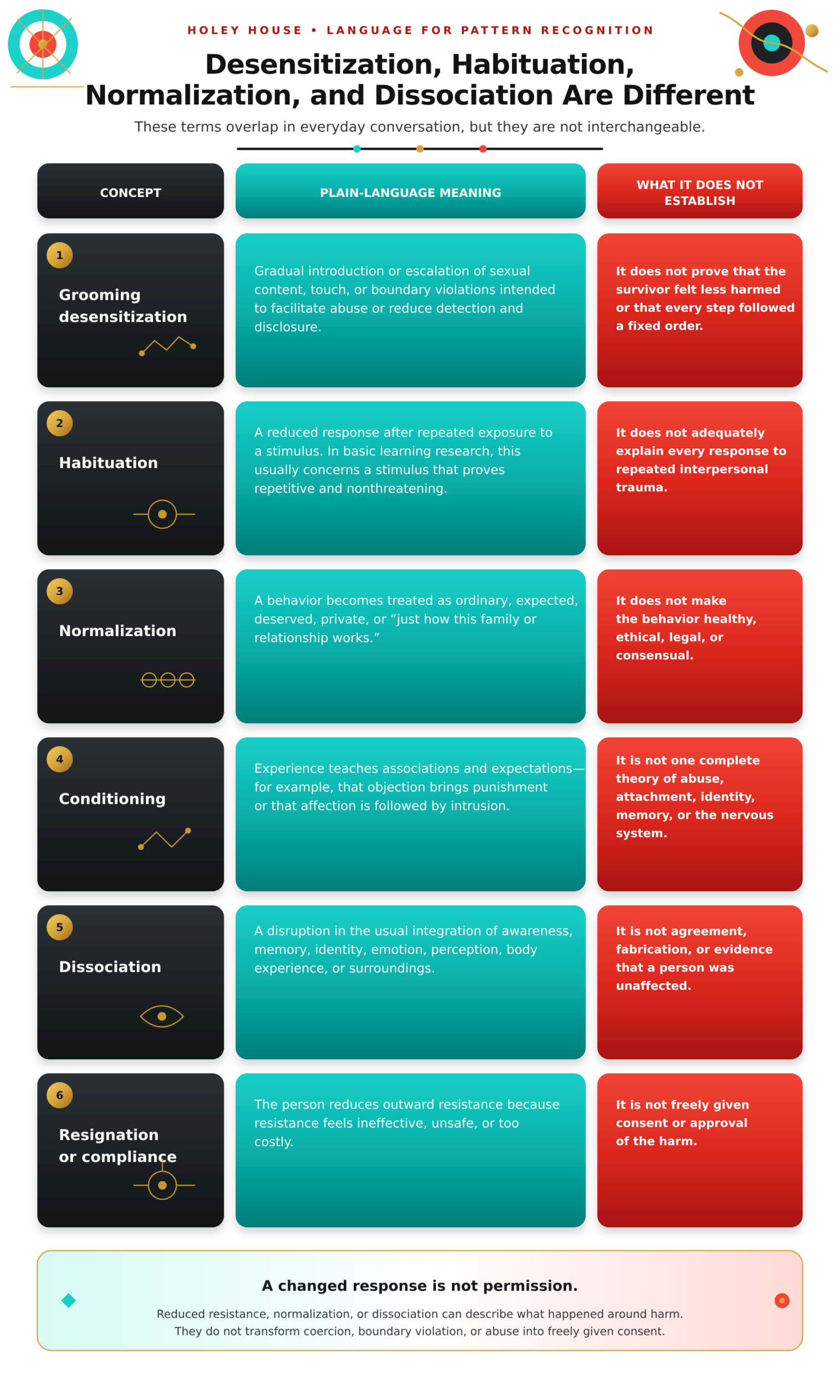
Repeated trauma does not produce one predictable curve in which alarm steadily falls. Research on traumatic stress describes both heightened threat responding and forms of emotional overmodulation or numbing. The National Child Traumatic Stress Network notes that children exposed to complex trauma may become vigilant and guarded, react intensely to reminders, avoid them, or have difficulty identifying and expressing internal states. That means the same survivor may appear “desensitized” in one moment and become highly activated in another. The body is not contradicting itself. It may be using different forms of protection in different conditions.
How Harm Becomes Familiar Without Becoming Safe
Desensitization is not merely repetition. It often depends on the meaning wrapped around the repetition. In incest, the abusive person may already occupy a role associated with care, authority, affection, privacy, obedience, or family loyalty. Sexualized behavior can then be blended into ordinary routines and interpreted for the child before the child has language to interpret it independently.
The behavior may be framed as:
- affection between people who are “especially close”
- education about bodies or sex
- play, joking, bathing, caregiving, or comfort
- a reward for maturity or loyalty
- a secret that protects the family
- proof that the child caused, wanted, or enjoyed what happened
- something too normal to question and too shameful to disclose
The child is not simply being exposed to behavior. The child is being taught what the behavior supposedly means and what questioning that meaning may cost.

Real lives do not remain inside tables. Some abuse begins suddenly. Some survivors resist throughout. Some never experience reduced alarm. Others feel numb during the abuse and terrified later, or terrified during the abuse and numb later. The map explains one possible process; it does not grade the credibility of a survivor’s story.
Desensitization Can Target the Surrounding Family or Institution
The survivor may not be the only person conditioned to see escalating behavior as ordinary. A family can become accustomed to sexual jokes, forced affection, open doors, intrusive caregiving, favoritism, secrecy, or one person’s exemption from rules. An institution can normalize private messaging, unsupervised access, unusual gifts, exceptions, or “special” relationships because each departure from policy seems small and the person is useful or well liked. When concern is finally raised, others may compare the latest behavior only with the immediately previous behavior instead of the original boundary. The line has moved so gradually that the final position feels familiar. This does not mean every permissive family or policy lapse proves sexual grooming. It means protective adults and organizations should evaluate observable patterns, power, secrecy, sexualization, access, escalation, rule exceptions, and the response to limits; not rely only on reputation or stated intent.
Common Myths About Desensitization and Normalized Abuse
Myth: Desensitized Means the Survivor No Longer Felt Harm
What we know: Reduced outward alarm may coexist with fear, pain, disgust, confusion, shame, dissociation, resignation, or intense internal vigilance. Some survivors do not show reduced alarm at all. The word describes a possible process of making content, contact, or violations more familiar. It is not a clinical measurement of how much the survivor suffered.
Myth: Familiarity Means Acceptance
What we know: Familiarity answers, “Have I encountered this before?” Acceptance answers, “Do I freely agree that this is okay?” Those are different questions. People can adapt to harmful conditions because those conditions are repeated, unavoidable, attached to needed relationships, or enforced by power. Adaptation helps explain survival. It does not approve the environment that required it.
Myth: A Child Who Did Not Object Must Have Been Comfortable
What we know: A child may not understand the sexual meaning of an interaction, may lack language, or may expect punishment, disbelief, family disruption, or loss of care. The CDC defines child sexual abuse in part by the child’s inability to fully comprehend or provide informed consent to the sexual activity. No adult is entitled to treat a child’s silence, stillness, affection, curiosity, or compliance as permission.
Myth: An Automatic Physical Response Means the Conditioning “Worked”
What we know: Bodies can produce involuntary responses during unwanted or abusive experiences. A physical sensation does not reveal a person’s values, desire, moral responsibility, or consent. Describing bodily response as cooperation places an automatic physiological event on trial while removing the choices of the person who caused the abuse.
Myth: If the Survivor Returned, the Harm Must Have Felt Normal or Good
What we know: Return can reflect attachment, family structure, dependence, routine, threats, hope, isolation, lack of alternatives, or the fact that a child lives with the person causing harm. Non-abusive connection may also exist alongside abuse. The question is not only, “Why did the survivor return?” It is also, “What power, needs, risks, relationships, and restricted exits made distance difficult or impossible?”
Myth: Desensitization Always Makes People Underreact
What we know: Repeated trauma can be associated with numbing or dissociation, but it can also be associated with heightened vigilance, startle, avoidance, intense emotional responses, and difficulty calming after reminders. Human stress responses do not move in only one direction. Calling every strong reaction “sensitization” and every quiet reaction “desensitization” may sound scientific while saying very little about the person’s actual experience.
Myth: Gradual Exposure Is Basically the Same as Therapeutic Exposure
What we know: Evidence-based therapeutic exposure is intended to help a consenting client approach safe trauma reminders within an ethical treatment plan. The U.S. Department of Veterans Affairs describes Prolonged Exposure as an individual therapy in which a client gradually approaches trauma-related memories, feelings, and safe situations with a provider. Grooming exposes a child to sexual content or contact to facilitate abuse, reduce barriers, or maintain secrecy. The surface similarity (something happens gradually) does not erase the opposite purposes, power conditions, consent, safeguards, or outcomes. Abuse is not accidental therapy.
Myth: Normalization Means the Survivor Believed the Abuse Was Morally Right
What we know: A person may treat something as expected without believing it is right. A child may know only that it happens, that adults permit it, or that protest makes things worse. “Normal” can mean familiar, frequent, unavoidable, family-approved, or difficult to imagine escaping. None of those meanings equals healthy.
Myth: Understanding Conditioning Removes All Survivor Agency
What we know: Contextualizing constrained choices is not the same as declaring survivors powerless. People can resist internally, protect others, seek small openings, reinterpret events later, disclose, leave, or reclaim boundaries in many ways. Agency does not need to be exaggerated to be respected. A child should not have been required to outmaneuver an adult. An adult facing coercion should not be judged as though every theoretical option was safe and available.
Myth: If Desensitization Was Not Present, the Abuse Does Not Count
What we know: Grooming is not required for child sexual abuse to occur. Abuse may be sudden, forceful, opportunistic, or carried out through authority and access that already exist. A survivor does not need to identify a conditioning sequence before their experience deserves recognition and care.
Myth: The Desensitization Framework Can Recover Missing Memories
What we know: A conceptual framework can organize what is already known or remembered. It cannot establish that a specific event occurred, fill gaps, or prove another person’s intent from symptoms alone. Survivors deserve validation without manufactured certainty. Both compassion and accuracy belong in the room.
How Desensitization and Normalization Affect Survivors
The deepest confusion may not be, “Did something happen?” It may be, “Why did it stop feeling unusual?” That question can carry brutal self-judgment. Survivors may believe that noticing less, reacting less, or continuing ordinary life means they agreed to the harm. The logic is backwards. When harm is repeated inside a relationship a person cannot safely leave, the ability to function around it may be part of survival. The adaptation belongs to the survivor. The responsibility for creating the harmful conditions does not.
Familiarity Can Distort the Survivor’s Definition of Normal
A person raised around sexualized boundaries, forced affection, invasive privacy, coercive caregiving, or family secrecy may enter later relationships without a clear comparison point. They may know that something feels uncomfortable but assume discomfort is simply the price of closeness. They may recognize extreme harm while missing earlier intrusions because the earlier behavior resembles home. This does not mean survivors are destined to repeat abuse or unable to recognize safety. It means learning occurs inside relationships, and the first relationship lessons are not always truthful.
Reduced Resistance Can Become a Source of Shame
Survivors are often asked to explain why they did not fight, tell, leave, or continue objecting. The question treats resistance as though it has no cost and no history. If earlier protest was ignored, mocked, punished, or followed by escalation, reducing outward resistance may have been an intelligent response to the available evidence. The survivor learned what the environment repeatedly demonstrated: objection did not reliably produce protection. Compliance under those conditions is an outcome of coercion, not evidence that coercion was absent.
Dissociation and Numbness May Be Misread as Indifference
Some survivors describe feeling unreal, far away, outside the body, emotionally blank, or unable to organize what happened into a continuous account. A meta-analysis by Vonderlin and colleagues found a robust association between childhood abuse or neglect and dissociation, although the strength of the association varied across studies and abuse characteristics. Dissociation is not specific to child sexual abuse, and its presence cannot prove a particular history. It may help explain why a survivor’s response, memory, or emotional expression does not resemble the dramatic story others expect. Quiet is not the same as untouched.
Alarm May Return After Safety, Distance, or New Language
A survivor may feel more distressed after the abuse ends, after leaving the family home, after entering a safer relationship, or after learning language that changes the meaning of old experiences. This does not automatically mean the memory is newly accurate in every detail, nor does it mean the earlier calm was fake. It may mean the person can now attend to information that survival once required them to set aside. I used to think late understanding was suspicious because truth should arrive on time. But trauma does not carry a little appointment book. Sometimes recognition waits until there is enough safety to be heard.
Long-Term Mental and Physical Health Relevance
Child sexual abuse is associated with increased risks for long-term mental, physical, behavioral, and relational difficulties. The CDC identifies associations that include depression, post-traumatic stress symptoms, substance misuse, suicidal behavior, later victimization, and some chronic physical health conditions.
The CSA Centre’s research summary also describes wide variation in impact and notes that dissociation can be a coping response during and after abuse. No symptom, diagnosis, or health condition proves that abuse occurred, and no single experience can be assumed to have caused an individual condition without proper assessment. These findings describe population-level associations, not destiny. Outcomes reflect many interacting influences, including other adversity, genetics, environment, discrimination, material resources, relationships, and access to care. The specific claim that a desensitization process directly causes a later physical or mental illness is not established. A more careful conclusion is that child sexual abuse and chronic interpersonal trauma are associated with long-term health risks, while normalization, dissociation, attachment, and coerced compliance may help explain parts of some survivors’ experiences.
Familiarity Is Conditioning, Not Consent
If this process was part of your story, you may have become familiar with what you never should have had to tolerate. You may have learned the routine. You may have anticipated the person’s mood, gone still, left your body, acted ordinary afterward, protected the secret, or needed the non-abusive parts of the relationship. Those responses do not testify against you. They testify to the conditions around you: the repetition, the power difference, the meanings supplied, the exits restricted, and the price attached to resistance. You did not turn harm into consent by surviving it more quietly.
How Partners Can Understand Desensitization in Trauma Survivors
Partners may hear “desensitized” and imagine that the survivor should be unaffected by a familiar touch, joke, conflict, or sexual situation. Trauma does not work that neatly. What became familiar in the abusive relationship may become alarming in a safe one. What seemed ordinary for years may become intolerable once the survivor has language, distance, or genuine choice. Responses can change without being manipulative or dishonest.
Do Not Use Past Tolerance as Present Permission
A survivor may have tolerated, initiated, or appeared comfortable with something before and refuse it now. Present consent does not become less valid because the boundary has changed. Statements such as “You were fine with this last week” or “This never bothered you before” can repeat the old lesson that familiarity creates permanent access. A more accurate understanding is simple: a previous response provides context, not ownership of the next moment.
Do Not Mistake Numbness for Comfort
A survivor who becomes still, agreeable, distant, unusually quiet, or difficult to read may not be communicating safety. Those behaviors can have many meanings, so partners should not diagnose dissociation from appearance alone. They should also not assume that the absence of protest equals active participation. Consent is clearer when there is room for choice, change, pause, and an answer that does not need to protect the other person’s feelings.
Expect Contradictory Reactions Without Demanding a Contradictory Story
A survivor may want closeness and then feel trapped by it. They may enjoy a form of touch one day and become distressed by it another day. They may grieve someone who harmed them or miss the good parts of the relationship. Mixed responses do not cancel one another. Attachment, memory, present context, bodily state, safety, and meaning can all shift how an experience is felt. The partner’s job is not to make every response fit one theory. It is to understand that complexity is not proof of deceit.
Recognize Why “Normal” May Be a Loaded Word
The survivor may have spent years believing that forced privacy loss, sexualized humor, emotional caretaking, interrogation, or unwanted touch was normal. A partner who says, “Every couple does this,” may accidentally repeat the authority-based normalization that made the original harm difficult to name. Healthy relationships do have shared expectations. They also allow those expectations to be discussed, refused, revised, and separated from punishment.
Support Without Becoming the New Interpreter of the Survivor
Learning about desensitization can help a partner become more compassionate. It should not become a tool for explaining the survivor to themselves. “You are only reacting this way because of your trauma” can erase a valid present preference. Not every no is a trauma symptom. Not every discomfort requires treatment. Sometimes the survivor simply does not want something. Understanding trauma should increase respect for the survivor’s interpretation, not give the partner a graduate degree in overruling it.
Hold Mutual Boundaries Without Punishment
The survivor’s history does not eliminate the partner’s needs or limits. A safe relationship is not one person disappearing to prove that the other person has choices. Mutual boundaries become trustworthy when they are clear, proportionate, and not used to force compliance. “I need to pause this conversation and return at seven” is different from disappearing until the survivor surrenders a boundary. The distinction is not whether anyone feels disappointed. The distinction is whether disappointment becomes a weapon.
Take Current Risk Seriously
If there is ongoing abuse, sexual coercion, stalking, threats, device monitoring, access to children, or fear of retaliation, learning the concept is not enough. Safety concerns should be addressed with qualified local support appropriate to the situation. Confronting a suspected abusive person without considering risk can increase danger. Partners can care deeply without seizing control. Support means making room for informed choice while refusing to minimize current harm.
Therapist Considerations for Desensitization, Dissociation, and Conditioned Compliance
The desensitization framework can help clinicians explain why abuse may become familiar, why resistance may decline, and why survivors often blame themselves for compliance. It can also become a blunt instrument if every muted response is labeled desensitization or every symptom is treated as evidence of grooming. Clinical usefulness depends on defining the term narrowly and holding uncertainty carefully.
Clarify Which Meaning of Desensitization Is Being Used
Ask whether the term refers to:
- documented grooming behaviors that gradually introduced sexual content or contact
- the survivor’s retrospective description of normalization
- reduced observable distress
- subjective numbness
- dissociation
- learned expectation that resistance would fail or be punished
- or a therapist’s inference about the process
These are related possibilities, not synonyms. Documenting the distinction prevents a teaching concept from quietly becoming a forensic conclusion.
Separate the Grooming Tactic From the Survivor’s Internal Response
An adult may introduce increasingly sexual content with the apparent purpose of facilitating abuse. That behavioral pattern can be examined without claiming to know exactly what happened inside the child at each stage. A child may become less reactive, more reactive, intermittently reactive, detached, compliant, or outwardly unchanged. The tactic and the response belong on separate lines of the formulation. This protects survivors from a hidden credibility test in which they must display the “correct” degree of desensitization for the grooming account to be believed.
Do Not Equate Flat Affect, Silence, or Compliance With Consent
The NCTSN cautions professionals that freezing or dissociating can look like shutting down or becoming quiet and that silence should not be assumed to mean understanding or consent. In therapy, a client who says yes quickly, goes blank, loses language, becomes unusually agreeable, or stops objecting may need the clinician to slow down and clarify choice. Those observations do not prove dissociation, but they should interrupt the assumption that procedural cooperation equals meaningful consent.
Avoid a One-Direction Nervous-System Story
Repeated trauma may be associated with hypervigilance, avoidance, intense activation, emotional numbing, dissociation, or combinations that change over time. Do not present desensitization as the nervous system “getting used to abuse” in one universal biological sequence. That language risks minimizing harm and overstating neuroscience. A more accurate formulation is that repeated interpersonal trauma can shape threat perception, attention, emotional expression, attachment, expectations, and protective behavior in varied ways.
Explore Meaning, Power, and Consequences, not Only Repetition
Repetition alone does not explain coercive normalization. Clinical inquiry may consider:
- how the behavior was named by the person causing harm
- the survivor’s age, development, and knowledge at the time
- the attachment or authority relationship
- what happened after discomfort, protest, disclosure, or withdrawal
- whether affection, rewards, ordinary care, threats, or shame surrounded the behavior
- what family, cultural, spiritual, or institutional rules made the conduct seem ordinary or unspeakable
- and what the survivor believed would be lost if they resisted
This keeps the analysis relational and contextual instead of reducing the survivor to a stimulus-response diagram.
Preserve Epistemic Humility Around Memory
A desensitization narrative can make fragmented or delayed recognition understandable. It cannot establish events that are not remembered or documented. Avoid suggesting missing steps, encouraging the client to complete a presumed sequence, or treating present symptoms as confirmation of specific abuse. It is possible to validate confusion, shame, and distress while distinguishing what is remembered, inferred, reported by others, documented, disputed, or unknown.
Make the Therapeutic Relationship Resistant to Normalization of Harm
Therapy should not gradually teach a survivor that discomfort must be overridden for progress. Trauma-informed care emphasizes safety, trustworthiness, collaboration, empowerment, voice, and choice. In practical ethical terms, this includes transparent roles, clear confidentiality limits, meaningful consent, permission to pause or disagree, predictable contact policies, careful attention to touch and self-disclosure, and repair when a boundary rupture occurs. The therapist should monitor rescue fantasies, exceptional access, unnecessary dependency, role drift, secrecy, and the belief that a beneficial intention makes client discomfort irrelevant. Harmful normalization can occur in professional settings when small exceptions accumulate and nobody steps back to examine the pattern.
Do Not Turn Psychoeducation Into a Verdict
Terms such as grooming, conditioning, desensitization, trauma bonding, and coercive control can bring relief because they shift attention from “Why did I allow it?” to “What conditions shaped what seemed possible?” They can also become totalizing. Offer concepts as lenses the client may evaluate, not identities or conclusions they must adopt. The client is allowed to say, “That fits part of my experience,” “That is not how it felt,” or “I do not know yet.”
Understand Disclosure as a Process
The CSA Centre describes disclosure as shaped by developmental, emotional, relational, community, and social factors. Many children do not verbally disclose until adulthood. Normalization, fear of consequences, attachment, shame, lack of language, and concern for family members may all make disclosure harder. Avoid treating a delayed, partial, indirect, or changing account as automatically deceptive. Also avoid assuming that every inconsistency is caused by trauma. Careful, non-leading inquiry and role-appropriate documentation remain essential.
Verify Safeguarding and Reporting Duties
When a current child or another legally protected person may be at risk, clinicians must follow the law, ethics code, licensing rules, and organizational procedures that apply to their jurisdiction and profession. The Child Welfare Information Gateway provides a general U.S. overview, but it is not a substitute for checking current local requirements. Explain confidentiality limits before sensitive disclosure when possible. If action is required, tell the client what will happen, what information must be shared, and where the client can retain voice. A reporting duty may limit choice; avoid adding avoidable secrecy to that loss of control.
Closing Reflection: Familiar Harm Was Never Harmless
I used to believe that if I had become accustomed to something, I must have accepted it. That belief confused adaptation with agreement. It ignored the child who was learning how to stay attached, how to keep the family intact, how to avoid making the next moment worse, and how to continue living inside a reality she did not have the power to redesign. Desensitization helps us see how the unbearable can be introduced in bearable-looking pieces. One intrusion is renamed. One objection is corrected. One secret becomes routine. One larger violation is placed beside yesterday’s smaller one until the distance between them becomes hard to see.
But the survivor’s adjustment does not cleanse the harm. Familiar harm is still harm. Expected harm is still harm. Harm endured without visible resistance is still harm. Harm mixed with love, gifts, laughter, care, loyalty, physical sensation, or ordinary family life is still harm. If you became numb, your numbness was not permission. If you remained alarmed, your alarm was not weakness. If you moved between the two, you were not inconsistent. You were a human being responding to conditions that changed, meanings that were manipulated, and choices that were constrained.
The question is not, “Why did I let it become normal?” A more honest question is: Who had the power to repeat the harm, define its meaning, punish resistance, restrict escape, and call the result normal? That question returns responsibility to the person and the system that created the conditions.
You did not consent to abuse by learning how to survive its repetition. You did not lose your truth because your alarm became quiet. And you do not need to perform devastation now to prove that what happened then mattered.
Next Step: Understand How Repeated Violations Can Lead to Boundary Collapse
Continue with the next topic, Boundary Collapse: When Repeated Violations Weaken the Sense of Choice, to examine how grooming, desensitization, punishment, and dependency can make personal limits feel unavailable even when the survivor still has preferences, values, and an inner no.
Closing Reflection Questions About Desensitization and Consent
What did “normal” mean in the environment where the harm occurred: healthy, frequent, expected, permitted, or unavoidable?
Which response have I judged most harshly; numbness, silence, compliance, attachment, return, or delayed recognition?
What power and consequences surrounded that response?
What becomes clearer when I separate familiarity from consent?
Whose choices created the conditions I had to adapt to?
Related Holey House Articles on Grooming, Boundary Violations, and Entrapment
Sexual Grooming Tactics & Stages in Child Sexual Abuse
Graduated Boundary Violations: How Tiny Intrusions Become Major Breaches
Mechanisms of Entrapment & Control
Research and Further Reading on Grooming Desensitization and Trauma
Winters, G. M., Jeglic, E. L., & Kaylor, L. E. (2020). Validation of the Sexual Grooming Model of Child Sexual Abusers. Journal of Child Sexual Abuse, 29(7), 855–875.
Jeglic, E. L., Winters, G. M., & Johnson, B. N. (2023). Identification of Red Flag Child Sexual Grooming Behaviors. Child Abuse & Neglect, 136, 105998.
Winters, G. M., Jeglic, E. L., Johnson, B. N., & Chou, C. (2024). The Prevalence of Sexual Grooming Behaviors Among Survivors of Childhood Sexual Abuse. Child Abuse & Neglect, 154, 106842.
Australian Government, National Office for Child Safety. Grooming.
Vonderlin, R., Kleindienst, N., Alpers, G. W., Bohus, M., Lyssenko, L., & Schmahl, C. (2018). Dissociation in Victims of Childhood Abuse or Neglect: A Meta-Analytic Review. Psychological Medicine, 48(15), 2467–2476.
Centers for Disease Control and Prevention. About Child Sexual Abuse.
Centre of Expertise on Child Sexual Abuse. The Impacts of Child Sexual Abuse and Identifying and Responding to Disclosures of Child Sexual Abuse.
National Child Traumatic Stress Network. Complex Trauma: Effects.
Substance Abuse and Mental Health Services Administration. Trauma-Informed Approaches and Programs.
U.S. Department of Veterans Affairs, National Center for PTSD. Prolonged Exposure for PTSD.

0 Comments